About Acherontia styx Westwood, 1847
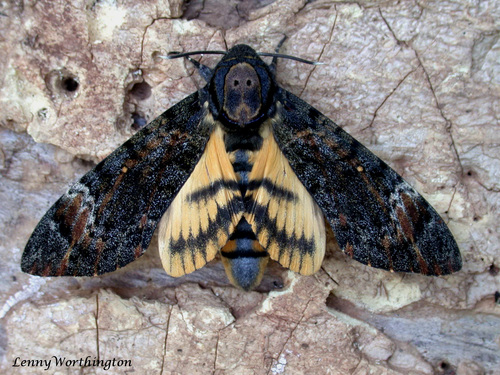
Acherontia styx Westwood, 1847 is similar to the European species A. atropos, but has distinct morphological differences. It has two medial bands on the underside of the forewing instead of one, and usually has no dark bands across the ventral surface of the abdomen. Its skull-like marking is darker, and the upperside of its hindwing has a faint blue tornal dot enclosed by a black submarginal band. Its forewing discal spot (stigma) is orange, while that of A. atropos is usually white. Two subspecies have been described: A. s. styx and A. s. medusa Moore, 1858. These two taxa intergrade widely, and current authorities consider A. s. medusa to only be a wet zone or wet season form, not taxonomically distinct. In The Fauna of British India, Including Ceylon and Burma: Moths Volume I, this species is described in further detail: the head is brown; the thorax is dark blue-grey, with black lateral lines that meet behind; the center of the thorax holds a fulvous skull-mark with two black eyes; the abdomen is yellow, with blackish segmental bands and a blue-grey stripe running down the vertex. The fore wing is mottled with various shades of brown, fulvous and grey; it has three indistinct antemedial lines, a pale spot at the end of the cell, and two lunulate curved postmedial lines. The hind wing is yellow with a postmedial black band that does not reach the costa or anal angle, plus a similar submarginal maculate band. This description again confirms the difference from A. atropos: two medial bands on the underside of the fore wing instead of one, and no bands on the underside of the abdomen. The larva is green, with oblique lateral yellow streaks on somites 4 through 10. The variant commonly referred to as A. styx medusa occurs throughout eastern continental Asia, from northeastern China (where it is a migrant) and Japan, south through eastern China and Vietnam to Peninsular Malaysia and peninsular Thailand. It is also found across all the islands of the Malay Archipelago. A. s. styx occurs from north-central and western China westward, across northern Thailand, Myanmar, Bangladesh, India, Sri Lanka, Nepal, Pakistan and Iran, to Saudi Arabia, Iraq, Jordan and Israel.