About Aceros nipalensis (Hodgson, 1829)
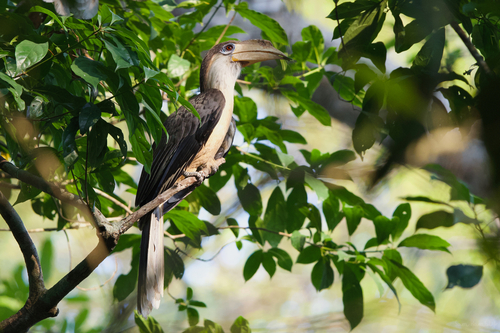
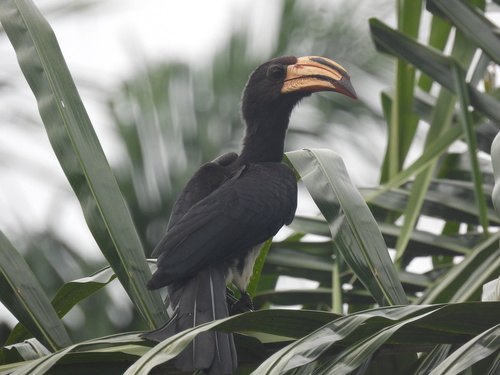
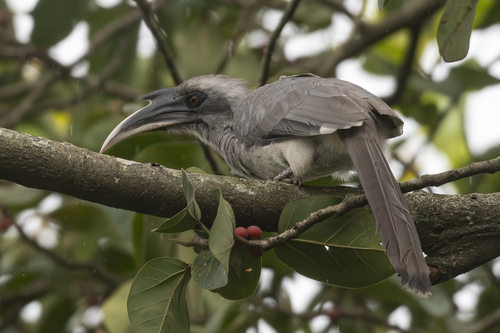
This species is scientifically named Aceros nipalensis (Hodgson, 1829), commonly called the rufous-necked hornbill. For adult males, the head, neck, and lower body are rufous, with deeper color on the flanks and abdomen. The middle primaries and the lower half of the tail are tipped white. The rest of the hornbill's plumage is glossy dark-green and black, and the lower tail-covert feathers are chestnut mixed with black. Adult females are entirely black except for the end of their tail and the tips of the middle primaries, which are white. Juvenile hornbills look similar to adult individuals of the same sex, but they do not have ridges at the base of the upper beak. The beak does not have a true casque, but is thickened at the base. The upper beak has several dark ridges; these ridges are absent in young birds, and their number increases with age up to around seven. The beak commissure is broken in both sexes. The rufous-necked hornbill has the northernmost distribution among its group, ranging from Northeast India, central Bhutan to western Thailand and northwestern Vietnam. Its total range covers 1,163,811 km² (449,350 sq mi), of which 825,837 km² (318,857 sq mi) is forested. Within this range, the species occurs in 90 protected areas that cover 54,955 km² (21,218 sq mi) of protected forest, but these protected areas only include 7% of the species' optimal habitat. Mahananda Wildlife Sanctuary in West Bengal marks the westernmost limit of its distribution; the species has also been recorded in Buxa Tiger Reserve, Manas National Park, Eaglenest Wildlife Sanctuary, Sessa Orchid Sanctuary, Kamlang Wildlife Sanctuary, Namdapha National Park and Pakke Tiger Reserve. It predominantly lives in ridged and hilly forests, mainly temperate broadleaf and mixed forests at elevations between 150 m (490 ft) and 2,200 m (7,220 ft). It has also been recorded in dry woodland. The nesting period of this species runs from March to June, and it prefers to nest in tall trees with broad girths. Communities of these hornbills move seasonally between different forests to forage on fruiting trees whose availability changes with local conditions. In 1889, Hume described the egg of this species as follows: the egg is a broad oval, slightly compressed towards one end, making it slightly pyriform. The shell is strong and thick, but coarse and completely without gloss, and is pitted all over with minute pores. The egg is a very dirty white with a pale dirty yellowish tinge; when examined closely, it is faintly stippled all over with minute purer white specks, which form because dirt does not reach the bottom of the pores. The egg measures 2.25 by 1.75 inches.