About Acer tataricum L.
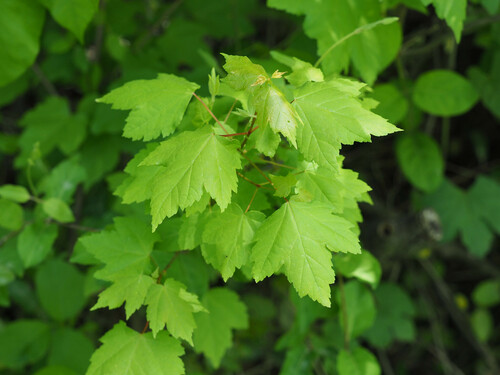
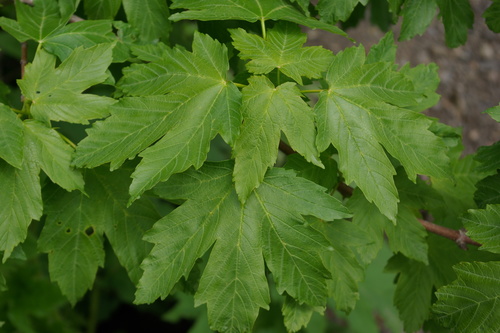
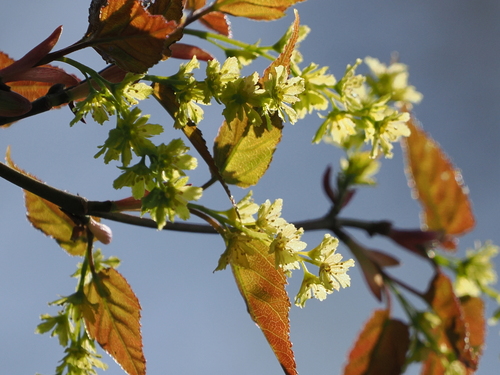
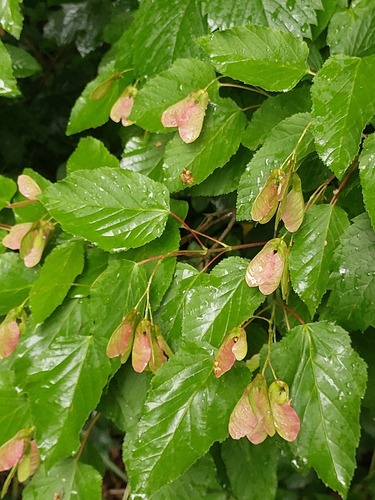
Acer tataricum L., commonly called Tatar maple, is a deciduous spreading shrub or small tree. It reaches 4 to 12 meters (13 to 39 ft) in height, and has a short trunk that grows up to 20 to 50 centimeters (7.9 to 19.7 in) in diameter, paired with slender branches. Its bark is thin, pale brown, and smooth on young growth, becoming shallowly fissured as the plant ages. The leaves are arranged oppositely, are simple in shape, broadly ovate, and measure 4.5 to 10 centimeters (1.8 to 3.9 in) long by 3 to 7 centimeters (1.2 to 2.8 in) wide. Leaves are either unlobed or have three to five shallow lobes, with a matte green upper surface, and a coarsely and irregularly toothed margin. The slender leaf petiole is often pink-tinged, and measures 2 to 5 centimeters (0.79 to 1.97 in) long. The whitish-green flowers are 5 to 8 millimeters (0.20 to 0.31 in) across, and form spreading panicles that emerge in spring as the leaves open. The fruit is a paired reddish samara; the whole fruit is 10 to 12 millimeters (0.39 to 0.47 in) long, with a 2 to 3 centimeter (0.79 to 1.18 in) wing, and matures from late summer to early autumn. Tatar maple is occasionally grown as an ornamental plant for gardens across Europe and North America. In Russia, it is valued for use in farmland shelterbelts. It is locally naturalised, and sometimes invasive, in eastern North America.