About Acer rufinerve Siebold & Zucc.
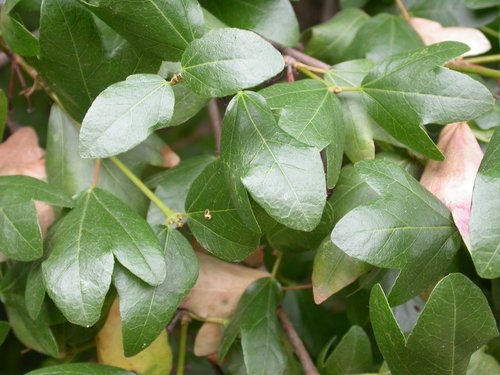
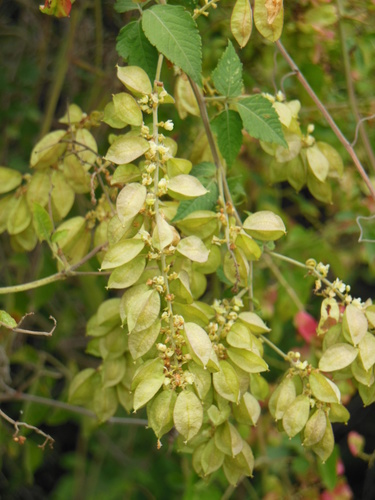
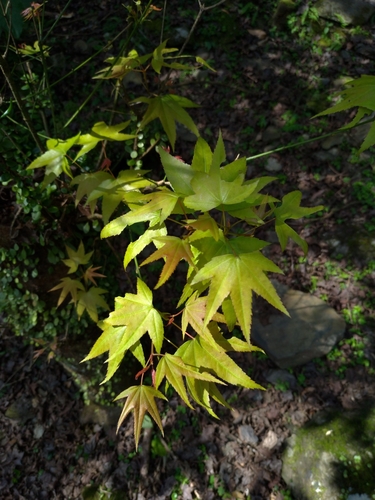
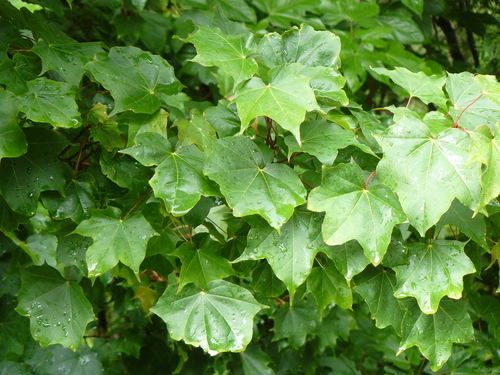
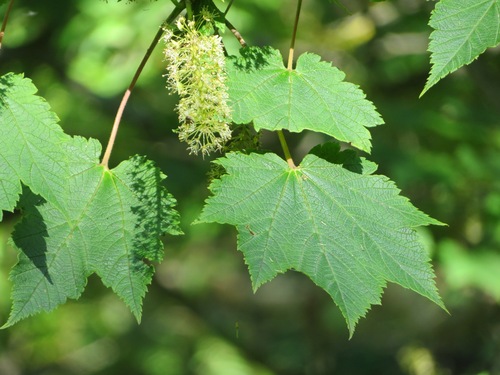
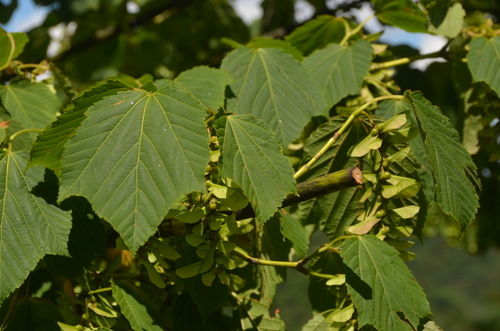
Acer rufinerve Siebold & Zucc. is a small deciduous tree that reaches 8 to 15 meters in height, with a trunk up to 40 centimeters in diameter. Young trees have smooth olive-green bark marked by regular narrow vertical pale green to greyish stripes and small greyish lenticels; bark becomes rough and grey on older trees. Its leaves are typically three-lobed, occasionally five-lobed with two additional small basal lobes, and have double serrated edges. Leaves measure 8 to 16 centimeters long and 6 to 16 centimeters broad, with a matt to sub-shiny dark green upper surface and a paler lower surface. Young leaves have small tufts of rusty hair on the lower veins, and become glabrous when mature. The leaf petiole is usually greenish, rarely pinkish, and 3 to 5 centimeters long. Leaves turn bright orange or red in autumn. Flowers are borne in 10-centimeter-long racemes, and each flower is 8 to 10 millimeters in diameter, with five yellow to greenish-yellow sepals and petals. The species is dioecious, meaning male and female flowers grow on separate individual trees. The fruit is a paired samara 2 to 3 centimeters long, with rounded nutlets. Acer rufinerve can be told apart from the closely related Acer capillipes, with which it often grows, by its green petioles, rufous hairs on the underside of its leaves (Acer capillipes has hairless or only thinly hairy leaves), and its earlier spring flowering that occurs as new leaves emerge. This species is one of the most commonly planted snakebark maples. It is a hardy, fast-growing tree, and shows little variation as a species, but several notable cultivars exist: 'Erythrocladum' has yellow-green color in both its leaves and its bark stripes; variegated cultivars include 'Albolimbatum' and 'Hatsuyaki'; 'Winter Gold' has bright golden-yellow bark.