About Acer rubrum L.
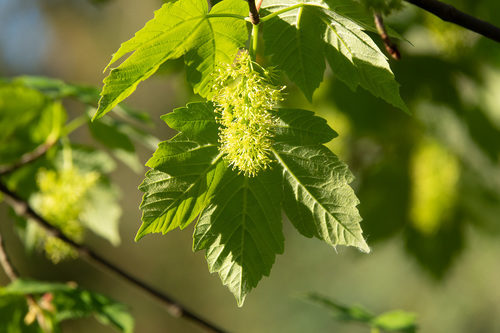
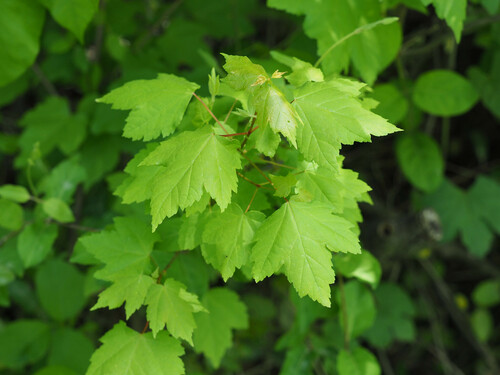
Acer rubrum L., commonly known as red maple, is highly variable in its morphological characteristics, even though it can sometimes be easy to identify. It is a medium to large tree that typically reaches 27 to 38 m (90 to 120 ft) in height; it can exceptionally grow over 41 m (135 ft) in the southern Appalachians, where growing conditions are favourable. On mature full-grown trees, leaves are usually 9 to 11 cm (3+1⁄2 to 4+1⁄4 in) long. Trunk diameter most often ranges from 46 to 88 cm (18 to 35 in), but open-grown trees can reach diameters up to 153 cm (60 in) depending on growing conditions. On forest-grown trees, the trunk remains free of branches for some distance upward. Individuals grown in open areas are shorter and thicker, with a more rounded crown. Trees growing on poor-quality sites often develop malformed, scraggly growth. Generally, the crown is irregularly ovoid, with ascending whip-like curved shoots. Young red maple has pale grey, smooth bark; as the tree ages, bark darkens and cracks into slightly raised long plates. The tallest known living red maple stands near Sevierville in Great Smoky Mountains National Park, at 43.59 m (143.0 ft) tall. The largest known individual grows near Armada, Michigan, reaching 38.1 m (125 ft) in height with a 4.95 m (16 ft 3 in) bole circumference at breast height. Red maple leaves are deciduous and arranged oppositely on twigs. They are roughly 5–10 cm (2–4 in) long and wide, with three to five palmate lobes and a serrated margin. Leaf sinuses are typically narrow, but leaves show considerable overall variation. Twigs are reddish, somewhat shiny, and marked with small lenticels, with dwarf shoots present on many branches. Buds are usually blunt, greenish to reddish, and generally have several loose scales. Lateral buds are slightly stalked, and collateral buds may also be present. Buds develop in fall and winter, and are often visible from a distance due to their large size and reddish colour. Leaf scars on twigs are V-shaped and contain three bundle scars. Red maple flowers are generally unisexual, with male and female flowers growing in separate sessile clusters, though they are sometimes bisexual. Flowers bloom from late winter to early spring, between December and May depending on elevation and latitude, and usually open before leaves emerge. The species is polygamodioecious: some individuals are male, some are female, and some are monoecious. Under the right conditions, trees can sometimes switch sexual expression: male to female, male to hermaphroditic, or hermaphroditic to female. Red maple typically begins blooming when it is around 8 years old, but this varies between trees; some begin flowering as early as 4 years old. Flowers are red with 5 small petals and a 5-lobed calyx, and usually grow at twig tips. Staminate flowers are sessile. Pistillate flowers grow on pedicels that lengthen during blooming, eventually forming a hanging cluster with stems 1 to 5 cm (1⁄2 to 2 in) long. Petals are linear to oblong and pubescent. Pistillate flowers have one pistil formed from two fused carpels, with a glabrous superior ovary and two long styles that protrude beyond the perianth. Staminate flowers contain between 4 and 12 stamens, most often 8. The fruit is a schizocarp made of 2 samaras, each 15 to 25 mm (5⁄8 to 1 in) long. Before dehiscence, the fruit wings diverge at an angle of 50 to 60°. Fruits grow on long slender pedicels, and range in colour from light brown to reddish. They ripen from April through early June, before leaf development is fully complete. After reaching maturity, seeds are dispersed over a 1- to 2-week period between April and July. Acer rubrum is one of the most abundant and widespread trees native to eastern North America. Its range extends from southern Newfoundland, through Nova Scotia, New Brunswick, and southern Quebec, to southwestern Ontario, extreme southeastern Manitoba, and northern Minnesota; it extends southward through Wisconsin, Illinois, Missouri, eastern Oklahoma, and eastern Texas along its western edge, and eastward to Florida. It has the largest continuous range along the North American Atlantic Coast of any tree that occurs in Florida. In total, its range spans 2,600 km (1,600 mi) from north to south. The species is native to all regions of the United States east of the 95th meridian. Its northern range ends at the −40 °C (−40 °F) mean minimum isotherm in southeastern Canada. A. rubrum is absent from most of the Prairie Peninsula of the northern Midwest, though it is found in Ohio, the coastal prairie of southern Louisiana and southeastern Texas, and the swamp prairie of the Florida Everglades. Its western range stops at the Great Plains, where conditions are too dry for the species to grow. The species' absence from the Prairie Peninsula is most likely due to its poor tolerance of wildfires. Red maple is most abundant in the Northeastern United States, the Upper Peninsula of Michigan, and northeastern Wisconsin, and rare in the extreme west of its range and in the Southeastern United States. The tree is absent from large areas in some regions but persists in a small number of specific habitats: for example, in the Bluegrass region of Kentucky, it is not found in the dominant open plains but grows along streams. In this area, it is absent from the bottom land forests of the Grain Belt, despite being common in similar habitats and species associations both north and south of this zone. In the Northeastern United States, red maple can be a climax forest species in some locations, but will eventually be replaced by sugar maple. A. rubrum grows well across an extremely wide range of soil types with varying textures, moisture levels, pH, and elevation, more so than almost any other North American forest tree. Its wide pH tolerance allows it to grow in many locations across the Eastern United States. It grows on both glaciated and unglaciated soils derived from granite, gneiss, schist, sandstone, shale, slate, conglomerate, quartzite, and limestone. Chlorosis may develop on very alkaline soils, but the species otherwise has a very high pH tolerance. Moist mineral soil is optimal for seed germination. Red maple grows across a variety of moist and dry biomes, from dry ridges and sunny southwest-facing slopes to peat bogs and swamps. Unlike many tree species, it does not show a preference for south-facing or north-facing growing aspects. Its ideal growing conditions are moderately well-drained, moist sites at low to intermediate elevations. Even so, it is common in mountainous areas on relatively dry ridges, as well as on both south and west upper slopes. It is also common in swampy areas, along slow-moving stream banks, and on poorly drained flats and depressions. In northern Michigan and New England, the tree grows on ridge tops, sandy or rocky upland, and other dry soils, and can form nearly pure stands on moist soils and at the edges of swamps. At the extreme southern edge of its range, it is almost exclusively found in swamps. Additionally, red maple is one of the most drought-tolerant maple species in the Carolinas. Red maple is far more abundant today than it was when Europeans first arrived in North America. It contributed only minimally to old-growth upland forests, and only formed single-species stands in riparian zones. The density of the tree in many areas has increased six- to seven-fold, and this upward trend continues. A primary driver of this increase is the loss of traditional forest management, including the loss of regular prescribed burns once performed by Native Americans to improve acorn and other seed harvesting. A second driver is continued heavy logging and the current trend of young, shrubby forests recovering from past human disturbance. Because it can grow on many types of substrates, tolerates a wide pH range, and grows in both sun and shade, A. rubrum is a prolific seed producer and highly adaptable, often dominating disturbed sites. While many sources suggest red maple is replacing historically dominant eastern tree species such as sugar maples, beeches, oaks, hemlocks, and pines, it only dominates young forests prone to natural or human disturbance. In human-disturbed areas where the species thrives, it can reduce plant diversity, but in mature forests it is not a dominant species; it has only a sparse presence and contributes to overall forest diversity and ecological structure. Extensive cultivation of red maple for landscaping has also contributed to the species' population increase, as volunteer seedlings spread widely. Finally, disease epidemics have greatly reduced elm and chestnut populations in United States forests. While dominant native forest trees still control mesic sites with rich soil, more marginal areas are increasingly dominated by red maple. The maximum lifespan of red maple is 150 years, but most individuals live less than 100 years. The tree's thin bark is easily damaged by ice, storms, animals, and lawn mower debris when planted in landscaping, which allows fungi to penetrate and cause heart rot. Its ability to thrive in so many habitats is largely due to its ability to develop roots suited to its site from a young age. In wet locations, red maple seedlings produce short taproots with long, well-developed lateral roots; on dry sites, they develop long taproots with much shorter lateral roots. Most roots grow horizontally, forming in the upper 25 cm (9.8 in) of soil. Mature trees have woody roots up to 25 m (82 ft) long. Red maple is very tolerant of flooding; one study found 60 days of flooding caused no leaf damage. At the same time, it is tolerant of drought because it can stop growing during dry conditions and produce a second flush of growth when conditions improve, even after growth stops for 2 weeks. A. rubrum is one of the first plants to flower in spring. A seed crop is produced most years, with a bumper crop occurring roughly every second year. A single tree with a diameter between 5 and 20 cm (2.0 and 7.9 in) can produce between 12,000 and 91,000 seeds in one growing season. One tree 30 cm in diameter was recorded producing nearly a million seeds. Red maple produces some of the smallest seeds of any maple species. Seeds are epigeal and tend to germinate in early summer shortly after release, when adequate light, moisture, and temperature conditions are met. If seeds are densely shaded, germination typically does not occur until the following spring. Red maple can increase its population significantly when associated trees are damaged by disease, logging, or fire. One study found that six years after clearcutting a 3.4-hectare (8.4-acre) oak-hickory forest with no pre-existing red maples, the plot held over 2,200 red maple seedlings per hectare (900 per acre) taller than 1.4 m (4.6 ft). Associate species black cherry (Prunus serotina) contains benzoic acid, an allelopathic compound that can inhibit red maple growth. Red maple is one of the first species to begin stem elongation. In one study, half of total stem elongation was completed in 1 week, after which growth slowed, and 90% of total growth was completed within 54 days. In good light and moisture conditions, seedlings can grow 30 cm in their first year, and up to 60 cm each year for the next few years, making the species a fast grower. Red maple acts as a food plant for Lepidoptera (butterflies and moths), including the larvae of the rosy maple moth (Dryocampa rubicunda). The maple shoot borer, Proteoteras aesculana, is a serious pest of cultivated maples. Caterpillars tunnel into shoots, weakening them; if a central shoot dies, the tree forks, though one branch may become the new leading shoot. Due to the species' very large range, there is significant variation in traits including hardiness, size, form, flushing time, and dormancy onset. In general, northern individuals flush earliest, produce the reddest fall colour, set buds earliest, and experience less winter injury. Seedlings are tallest in the north-central and east-central parts of the species' range. In Florida, at the extreme southern end of red maple's range, it grows only in swamplands. Fruit traits vary geographically: northern individuals growing in areas with brief frost-free periods produce shorter, heavier fruits than southern individuals. This variation gives significant genetic potential for breeding programs focused on producing cultivated red maples, which is especially useful for developing urban cultivars resistant to verticillium wilt, air pollution, and drought. Red maple frequently hybridizes with silver maple; the resulting hybrid is known as Freeman's maple, Acer × freemanii, and has intermediate traits between its two parent species. The leaves of red maple, especially when dead or wilted, are extremely toxic to horses. The toxin is not confirmed, but it is believed to be an oxidant that damages red blood cells, causing acute oxidative hemolysis that inhibits oxygen transport. This reduces oxygen delivery to all body tissues, leads to methemoglobin production, and can cause further kidney damage. Ingestion of 700 grams (1.5 pounds) of leaves is considered toxic, and 1.4 kilograms (3 pounds) is lethal. Symptoms develop within one to two days after ingestion, and include depression, lethargy, increased respiratory rate and depth, increased heart rate, jaundice, dark brown urine, colic, laminitis, coma, and death. Treatment options are limited, and may include methylene blue, mineral oil, activated charcoal to block further toxin absorption, blood transfusions, fluid support, diuretics, and antioxidants such as Vitamin C. Between 50% and 75% of affected horses die or are euthanized after ingestion. Red maple's rapid growth, ease of transplanting, attractive form, and value for wildlife in the eastern US have made it one of the most extensively planted trees. In parts of the Pacific Northwest, it is one of the most common introduced trees. Its popularity in cultivation comes from its vigorous growth habit, attractive early red flowers, and most importantly, its bright flaming red fall foliage. It was introduced to the United Kingdom in 1656 and entered cultivation shortly after, where it is now commonly found in many parks and yards. Red maple is a good choice for urban areas where there is ample space for its root system. Forming an association with arbuscular mycorrhizal fungi helps A. rubrum grow along city streets. It is more tolerant of pollution and road salt than sugar maple, although its fall foliage is less vibrant when grown in urban environments. Like several other maples, its shallow root system can be invasive, so it is a poor choice for planting near paving. It attracts squirrels, which eat its buds in early spring, though squirrels prefer the larger buds of silver maple. Red maple makes a vibrant, colourful bonsai, with attractive features for year-round display. In the lumber industry, Acer rubrum is classified as a "soft maple", a commercial designation it shares with silver maple (A. saccharinum). In this context, "soft" is a comparative rather than descriptive term: while red maple is softer than its harder relative sugar maple (A. saccharum), it is still a fairly hard wood comparable to black cherry (Prunus serotina). Like sugar maple, red maple wood is close-grained, but it has a softer texture, lower density, and is considered less visually attractive, particularly under a clear finish. Despite this, red maple wood is typically less expensive than hard maple, has greater dimensional stability than sugar maple wood, and machines and stains more easily. High grades of red maple wood can therefore be substituted for hard maple, especially for making stain or paint-grade furniture. Red maple lumber also has a higher percentage of "curly" (also called "flame" or "fiddleback") figuring, which is prized by musical instrument and custom furniture makers, as well as the veneer industry. As a soft maple, its wood tends to shrink more during drying than hard maple. Red maple is used to produce maple syrup, though the hard maples Acer saccharum (sugar maple) and Acer nigrum (black maple) are more commonly used for this purpose. One study compared sap and syrup from sugar maple with that from red maple, silver maple, boxelder, and Norway maple, and found all were equal in sweetness, flavour, and quality. However, red maple and other soft maples produce buds that emerge much earlier in spring than sugar maple, and after sprouting the sap's chemical makeup changes, which gives syrup an undesirable flavour. This means red maple can only be tapped for syrup before buds emerge, resulting in a very short tapping season. Native Americans used red maple bark as a wash for inflamed eyes and cataracts, and as a remedy for hives and muscular aches. They brewed tea from the inner bark to treat coughs and diarrhea. European pioneers made cinnamon-brown and black dyes from bark extract, and added iron sulphate to red maple bark tannin to make ink.