About Acer platanoides L.
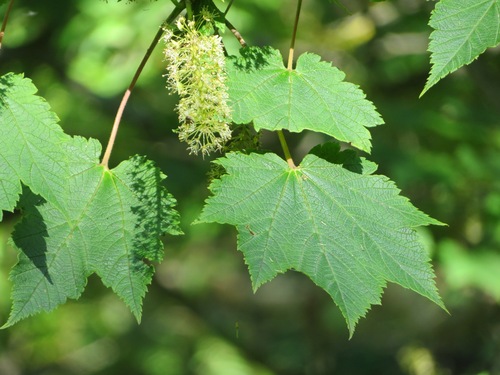
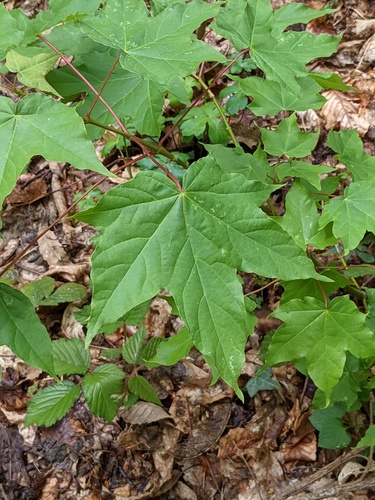
Acer platanoides L., commonly known as Norway maple, is a deciduous tree that reaches 20–30 m (65–100 ft) in height, with a trunk up to 1.5 m (5 ft) in diameter and a broad, rounded crown. Its bark is grey-brown and shallowly grooved, and unlike many other maples, mature trees do not develop shaggy bark. Shoots are green when young, and quickly turn pale brown; winter buds are shiny red-brown. Leaves are arranged oppositely, are palmately shaped with five lobes, and measure 7–14 cm (2+3⁄4–5+1⁄2 in) long and 8–25 cm (3+1⁄4–9+3⁄4 in) across. Each lobe has 1 to 3 side teeth, with the rest of the leaf margin being smooth. The leaf petiole is 8–20 cm (3+1⁄4–7+3⁄4 in) long, and releases milky juice when broken. Autumn leaf color is usually yellow, and occasionally orange-red. Flowers grow in corymbs of 15 to 30 flowers, are yellow to yellow-green with five sepals and five petals 3–4 mm (1⁄8–3⁄16 in) long. Flowering occurs in early spring, before new leaves emerge. The fruit is a double samara with two winged seeds. The seeds are disc-shaped and strongly flattened, measuring 10–15 mm (3⁄8–5⁄8 in) across and 3 mm (1⁄8 in) thick. The seed wings are 3–5 cm (1+1⁄4–2 in) long, are widely spread at an angle approaching 180 degrees. This species typically produces a large quantity of viable seeds. Under ideal conditions within its native range, Norway maple can live up to 250 years, though it often has a much shorter lifespan; for example, it sometimes lives only 60 years in North America. When planted as a street tree, it often has insufficient space for its root system, and roots are prone to wrapping around themselves, girdling and killing the tree. Additionally, its roots are generally quite shallow, which lets it easily out-compete nearby plants for nutrient uptake. Because its wood is not strong, branches often break during storms, leading to significant damage and cleanup costs for municipalities and homeowners. Norway maple is the type species of the section Platanoidea Pax, which is defined by flattened, disc-shaped seeds and milky sap in shoots and leaves. Other related species in this section include Acer campestre (field maple), Acer cappadocicum (Cappadocian maple), Acer lobelii (Lobel's maple), and Acer truncatum (Shandong maple). Norway maple can be distinguished from field maple by its larger leaves with pointed rather than blunt lobes, and from the remaining related species by the presence of one or more teeth on all lobes. It is often confused with the more distantly related Acer saccharum (sugar maple). Sugar maple is easy to tell apart by the clear sap in its petiole (leaf stem), while Norway maple petioles have milky white sap. The lobe tips of Norway maple leaves end in a fine sharp point, while the lobe tips of sugar maple leaves are rounded on close inspection. On mature trees, sugar maple bark is shaggier, while Norway maple bark has small, often criss-crossing grooves. While lobe shape and angle vary somewhat within all maple species, Norway maple leaf lobes are typically more triangular (acuminate), unlike sugar maple lobes, which are more finely toothed and narrow toward the base. Flowering and seed production begins when the tree is 10 years old, but large seed crops are only produced once the tree reaches 20 years of age. Norway maple is heterodichogamous, meaning populations include both protogynous and protandrous trees (and more rarely, duodichogamous trees), and individual trees may change their sexual expression from year to year. The paired samaras of Norway maple have widely diverging wings, which separates them from the samaras of sycamore (Acer pseudoplatanus), whose wings are at a 90-degree angle to each other. Norway maple seeds are flattened, while sugar maple seeds are globose. Sugar maple usually has a brighter orange autumn color, while Norway maple's autumn color is usually yellow, though some red-leaved cultivars are more orange. Norway maple flowers emerge in spring before leaves open, and flowers last 2–3 weeks. Leaf out occurs when air temperatures reach roughly 12°C (55°F) and there are at least 13 hours of daylight. Leaf drop in autumn starts when day lengths shorten to approximately 10 hours. Depending on latitude, leaf drop can vary by up to three weeks, starting in the second week of October in Scandinavia and the first week of November in southern Europe. Unlike some other maples that require warm soil for germination, A. platanoides seeds only need three months of exposure to temperatures below 4 °C (40 °F), and will sprout in early spring, around the same time leaf out begins. Norway maple does not require freezing temperatures for proper growth, but it is adapted to higher latitudes with long summer days, and does not perform well when planted south of the 37th parallel, the approximate southern limit of its native range in Europe. Most North American Norway maples are thought to descend from stock originating from Germany, between 48°N and 54°N, rather than the more southerly ecotypes from Italy and the Balkans that evolved for lighting conditions similar to those in the continental United States. The heavy annual seed crop and high germination rate contribute to its invasiveness in North America, where it forms dense single-species stands that displace native vegetation. This tree can also grow in low light under a forest canopy, leafs out earlier than most North American native maple species, and has a longer growing season because the lighting conditions in the United States cause fall dormancy to occur later than it does at the higher latitudes of Europe. It is one of the few introduced species that can successfully invade and colonize undisturbed virgin forest. In comparison, within its native range, Norway maple is rarely a dominant species, and instead mostly occurs as a scattered understory tree. The wood of Norway maple is hard, and ranges from yellowish-white to pale reddish, with no distinct heartwood. It is used for furniture and woodturning. Norway maple falls between hard and soft maple classifications, with a Janka hardness of 1,010 lbf (4,500 N). The wood is rated non-durable to perishable for decay resistance. In Europe, it is used for furniture, flooring, and musical instruments, particularly violin construction. Norway maple has been widely brought into cultivation outside its native range, including western Europe northwest of its original native distribution. It grows north of the Arctic Circle at Tromsø, Norway. In North America, it is planted as a street and shade tree as far north as Anchorage, Alaska. In Ontario, it is common in cultivation north to Sault Ste. Marie and Sudbury; while it is not considered reliably hardy further north, it has become established at Kapuskasing, Iroquois Falls, and even Moose Factory. It is most recommended for USDA Hardiness Zones 4 to 7, but will grow in warmer zones (at least up to Zone 10) where summer heat is moderate, such as along the Pacific coast south to the Los Angeles basin. It tends to prefer wetter Oceanic climates. During the 1950s and 1960s, it became popular as a street tree after large numbers of American elms were lost to Dutch elm disease. It is favored for its tall trunk and tolerance of poor, compacted soils and urban pollution, conditions that sugar maple does not tolerate well. It has become a popular species for bonsai in Europe, used for medium to large bonsai sizes and many different styles. Norway maples are not typically cultivated for maple syrup production, because their sap has lower sugar content than that of sugar maple.