About Acer negundo L.
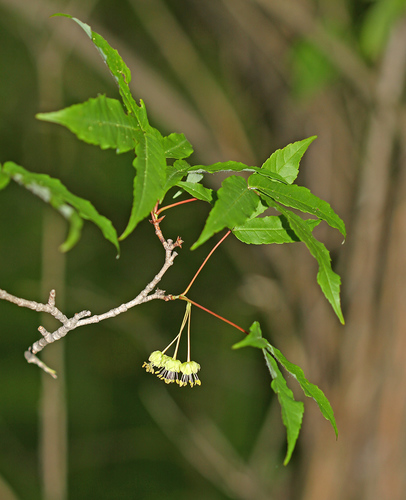
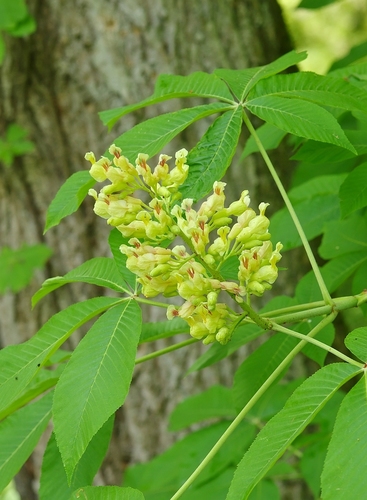
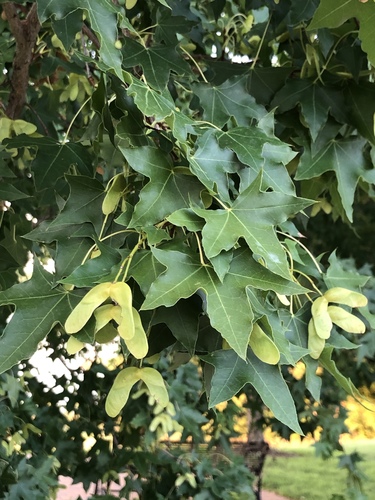
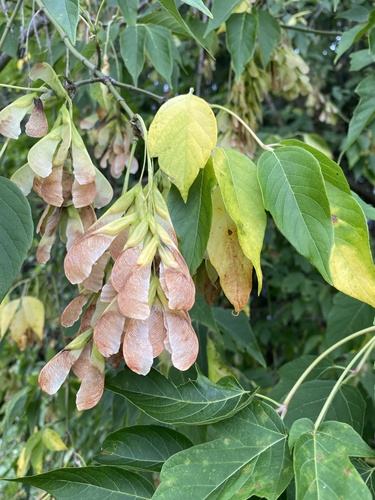
Acer negundo L., commonly called box elder, is a fast-growing, relatively short-lived tree. It typically reaches 10–25 metres (35–80 feet) in height, with a trunk diameter of 30–50 centimetres (12–20 inches), and rarely reaches up to 1 m (3 ft 3 in) in diameter. It often grows multiple trunks and can form dense, impenetrable thickets. Its usual lifespan ranges from 60 to 75 years, though it can live up to 100 years under exceptionally favorable conditions. Young shoots are green, and often have a whitish, pink, or violet waxy coating when new. Branches are smooth, somewhat brittle, and stay green instead of developing thick protective dead bark. Trunk bark is pale gray or light brown, deeply split into broad, scaly ridges. Unlike most other maples, which typically have simple palmately lobed leaves, Acer negundo has pinnately compound leaves that usually have three to seven leaflets. Simple leaves occasionally occur; these are technically compound leaves with only a single leaflet. While a small number of other maples (such as Acer griseum, Acer mandshuricum, and the closely related A. cissifolium) have trifoliate leaves, only A. negundo regularly produces more than three leaflets per leaf. Leaflets are around 5–10 cm (2–4 in) long and 3–7 cm (1+1⁄4–2+3⁄4 in) wide, with slightly serrated edges. Leaves are translucent light green, and turn yellow in autumn. Its small yellow-green flowers emerge in early spring: staminate (male) flowers grow in clusters on slender stalks, while pistillate (female) flowers grow on drooping racemes 10–20 cm (4–8 in) long. The fruit is a schizocarp made of two single-seeded, winged samaras arranged in drooping racemes. Each slender seed is 1–2 cm (1⁄2–3⁄4 in) long, with a 2–3 cm (3⁄4–1+1⁄4 in) incurved wing. These seeds drop in autumn, but may remain on the tree through winter. Seeds are almost always prolific and fertile. Unlike most other maples, A. negundo is fully dioecious: reproduction requires both a male and a female tree, since male and female flowers grow on separate individual plants. Male clusters typically hold four flowers each, while female flowers form a raceme. Acer negundo is native to most of the United States (primarily the eastern portion), south-central Canada, and ranges as far south as Guatemala. Box Elder County, Utah, and the town of Box Elder, South Dakota, are both named for this tree. Though native to North America, it is considered a weedy species in some areas, including parts of the Northeastern United States, where its population has increased greatly. In 1928, Joseph Illick, chief forester for the state of Pennsylvania, wrote in Pennsylvania Trees that box elder was "rare and localized" in the state. After World War II, box elder's rapid growth made it a popular landscaping tree for suburban housing developments, despite its poor form, vulnerability to storm damage, and tendency to attract large numbers of box elder bugs. Intentional cultivation has made the tree much more abundant than it was historically. It can quickly colonize both cultivated and uncultivated areas, so its range is expanding both in North America and beyond. It was introduced to Europe in 1688 as a park tree, and it spreads quickly enough to be considered an invasive species in parts of Central Europe, including Germany, the Czech Republic, Hungary, Slovenia, Poland, and Russia, where it forms dense stands in lowlands, disturbed areas, and riparian biomes on calcareous soils. It has also naturalized in eastern China, is listed as an invasive pest species in some cooler areas of Australia, and is invasive in the Rio de la Plata area. This species prefers full bright sunlight, and often grows on floodplains and other disturbed areas with abundant water, such as riparian habitats. Human activity has greatly benefited this species; it grows around homes, in hedges, on disturbed ground, and in vacant lots. Multiple species of birds and some squirrels feed on its seeds, and the evening grosbeak relies on them heavily. The boxelder bug (Boisea trivittata) lays its eggs on all maple species, but prefers Acer negundo, clustering eggs in bark crevices. The rosy maple moth (Dryocampa rubicunda) also lays eggs on the leaves of maple trees, including Acer negundo. Its larvae feed on the leaves, and very dense populations can cause complete defoliation. Small galls form on the leaves from the bladder mite Aceria negundi. The gall midge Contarinia negundinis joins these galls and enlarges them, and sometimes creates separate tubular galls on the midrib or veins on the undersides of leaves. The cottony maple leaf scale Pulvinaria acericola occurs on the foliage of Acer negundo. The leaf spot fungus Septoria negundinis produces black-ringed lesions on the tree's leaves. A protoxin called hypoglycin A found in Acer negundo seeds has been identified as a major risk factor, and possibly the cause, of seasonal pasture myopathy (SPM), a seasonal equine neurological disease found in parts of North America and Europe. Symptoms of SPM include stiffness, difficulty walking or standing, dark urine, and eventually rapid breathing and becoming recumbent. Ingesting enough box elder seeds or other plant parts causes breakdown of respiratory, postural, and cardiac muscles. The cause of SPM was unknown for centuries even though the disease was well known in affected regions, and was only confirmed in the 21st century. This condition is analogous to Jamaican vomiting sickness in humans, which is also caused by hypoglycin A. Acer negundo pollen, released in winter or spring depending on latitude and elevation, is a severe allergen. Despite having weak wood, irregular growth form, and prolific seeding that might make it seem an unsuitable landscape tree, A. negundo is one of the most common maples in cultivation. It has been successfully grown long-term as far north as Yellowknife. Many cultivars have been developed, including: 'Auratum' with yellowish leaves and smooth undersides; 'Aureomarginatum' with creamy yellow leaf margins; 'Baron', a hardier, seedless variety; 'Elegans' with distinctly convex leaves; 'Flamingo' with pink and white variegation, which is very popular; 'Pendulum' with weeping branches; 'Variegatum' with creamy white leaf margins; and 'Violaceum' with bluish color on young shoots and branches. Native American groups have used Acer negundo for several medicinal purposes. The Cheyenne burn its wood as incense during the making of spiritual medicines and Sun Dance ceremonies. The Meskwaki and Ojibwa both use a decoction or infusion of the inner bark as an emetic. Native American groups have also used the species for food. The sap has been used to make syrup by the Dakota, Omaha, Pawnee, Ponca, Winnebago, Cree, Sioux, and indigenous peoples of Montana. The Chiricahua and Mescalero Apache dry scraped inner bark to store as winter food, and boil the inner bark until sugar crystallizes out of it. The Cheyenne mix boiled sap with shavings from the inner sides of animal hides to eat as candy. The Ojibwa mix its sap with sugar maple sap to drink as a beverage.