About Acer macrophyllum Pursh
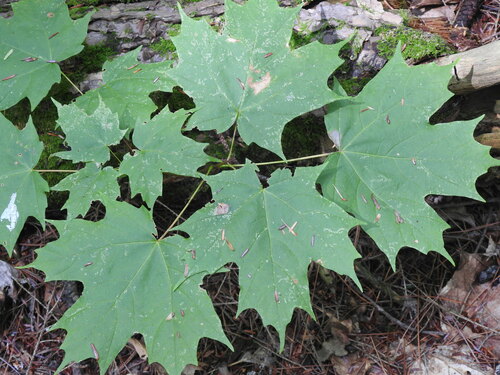
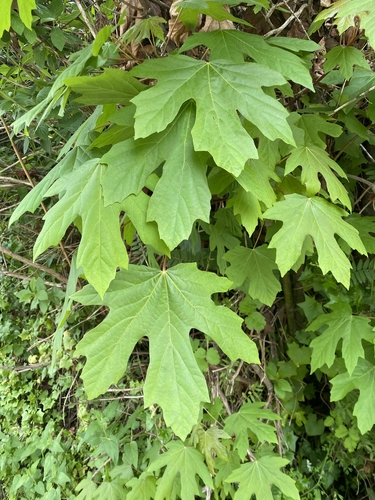
Bigleaf maple (Acer macrophyllum Pursh) can reach a maximum height of 48 metres (158 feet), but most mature trees grow 15–20 m (50–65 ft) tall, with trunk diameters of 90–120 centimetres (35–47 inches). The current U.S. national champion bigleaf maple by size is located in Lane County, Oregon; it stands 36 m (119 ft) tall, has a crown spread of 28 m (91 ft), and an average diameter at breast height (dbh) of about 3.7 m (12 ft). The previous national champion, located in Marion, Oregon, is 27 m (88 ft) tall, with a 32 m (104 ft) crown spread and an average dbh of about 2.5 m (8 ft). Its bark is gray-brown, and it darkens and develops ridges as the tree ages. This species has the largest leaves of any maple: most leaves measure 15–30 cm (6–12 in) across, with five deeply incised palmate lobes, and the largest recorded leaf on a living tree reaches 61 cm (24 in) across. Leaf stems are 15–30 cm (6–12 in) long and contain milky sap. In autumn, bigleaf maple leaves turn shades of gold and yellow, which stand out against evergreen conifer backdrops. In early spring, before leaves emerge, the tree produces greenish-yellow flowers clustered in hanging pendulous racemes 10–15 cm (4–6 in) long, with inconspicuous petals. Bigleaf maple is hermaphroditic, meaning each raceme holds both male and female flowers. Its fruit is a paired winged samara; each seed is 1–1.5 cm (3⁄8–5⁄8 in) in diameter, with a 4–5 cm (1+5⁄8–2 in) wing. Bigleaf maple begins producing seed at around 10 years of age. An unofficial largest recorded bigleaf maple leaf was discovered around 1990 at Shawnigan Lake, Vancouver Island, British Columbia, Canada, measuring 63.4 cm wide by 52.3 cm high, not including the stem. In May 2018, the two oldest bigleaf maples in Europe, which were 175 years old, were removed from Trinity College Dublin (TCD) in Ireland. One tree had started to rot internally and fell during stormy, windy weather; the second was also infected and was cut down because the same collapse was expected. Both trees grew in a grassy area adjacent to TCD's campus that was originally All Hallows cemetery, now the college's Front Square. Bigleaf maple occurs primarily near the Pacific coast of North America, west of the Coast Ranges of British Columbia and the Cascade Range, ranging from southernmost Alaska to southern California. Some small stands grow inland in the foothills of the Sierra Nevada in central California, and a tiny isolated population is found in central Idaho. It typically grows from sea level up to 450 m (1,480 ft) elevation, and can grow as high as 1,200 m (3,900 ft) in exceptional cases. It can form pure stands on moist soil near streams, but it is generally found in riparian hardwood forests, or scattered under or within the relatively open canopies of conifers, mixed evergreens, or oaks (Quercus spp.). In cool, moist temperate mixed forests, it is one of the dominant tree species. While it is very rare in the wild north of Vancouver Island, it is cultivated in Prince Rupert, near Ketchikan, and in Juneau. Bigleaf maple can grow in a wide range of habitats, but it thrives in fairly well-watered hardwood forests, where it grows alongside red alder, black cottonwood, and willows. It is fairly shade tolerant, though less shade tolerant than vine maple, and benefits from ecological disturbances. It is not considered fire-resistant due to its thin bark, but large mature trees with thick bark may survive moderate fires. Along with red alder, bigleaf maple often dominates early postfire succession in Douglas-fir forests, and wildfire can increase its presence in these forests. It prolifically spreads and grows vegetatively from cuttings and stumps of any size. Insects pollinate the tree's flowers. Squirrels and wintering grosbeaks eat its winged fruits. Deer mice have been observed eating bigleaf maple seeds in spring in the Sierra Nevada. Ungulates including black-tailed deer, mule deer, elk, and horses browse the tree's foliage, along with mountain beavers and other rodents. A study in western Oregon found that 60% of bigleaf maple seedlings taller than 25 cm (10 in) had been browsed by deer, most multiple times. Bigleaf maple is a preferred habitat for barred owls, which are an invasive species in Pacific coast range habitats, and the presence of the tree is positively associated with Hammond's flycatchers. In wetter parts of its native range, such as Olympic National Park and the lowland forests around Puget Sound, bigleaf maple bark is often covered with epiphytes including club moss and licorice fern. Older bigleaf maple trees typically develop heart rot. Native Americans grew sprouts from bigleaf maple seeds for food, wove baskets from the tree's inner bark, and used the leaves to line cooking pits to cover food. They also carved the wood into dishes, utensils, and canoe paddles. Maple syrup can be made from the sap of bigleaf maple trees; its sugar concentration is about the same as that of Acer saccharum (sugar maple), but its flavor is distinct. There has been limited interest in commercial syrup production from bigleaf maple sap. Even though it is not traditionally used for syrup production, the ratio of sap to finished syrup is approximately 40 volumes of sap to produce 1 volume of syrup. Bigleaf maple buds are also edible, and are often fried to make fritters.