About Acer grandidentatum Nutt. ex Torr. & A.Gray
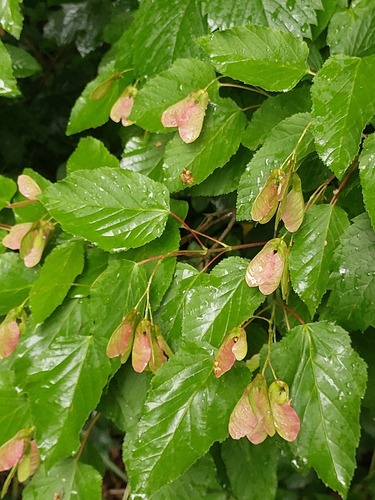
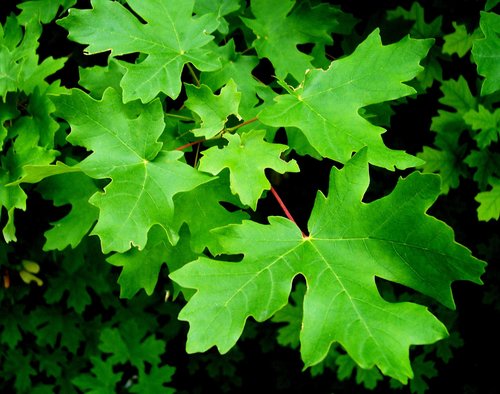
Acer grandidentatum Nutt. ex Torr. & A.Gray is a small to medium-sized deciduous tree that reaches 10–15 meters (33–49 feet) in height, with a trunk 20–35 centimeters (8–14 inches) in diameter. Its bark ranges from dark brown to gray, marked by narrow fissures and flat ridges that form plate-like scales; the bark is thin and easily damaged. The leaves are opposite and simple, measuring 6–12 cm (2 1/4–4 3/4 inches) long and wide, with three to five deep, bluntly-pointed lobes. Three of these lobes are large, while two smaller lobes at the leaf base are not always present. Each of the three main lobes holds 3–5 small subsidiary lobules. In autumn, the leaves turn golden yellow to red, though this color change is less reliable in warmer areas. Specimens growing in Texas do not develop good autumn color during heavy seed production years. Flowers emerge alongside new leaves in mid-spring, produced in corymbs holding 5–15 flowers each. Individual flowers are yellow-green, around 4–5 millimeters in diameter, and lack petals. The fruit is a paired samara, consisting of two winged seeds joined at the base. Unripe samaras are green to reddish-pink, and mature to brown in early fall. Each globose seed is 7–10 mm (1/4–3/8 inch) in diameter, with a single wing 2–3 cm (3/4–1 1/4 inch) long. This species grows from the Rocky Mountains in southeast Idaho, southward through Utah. It most commonly grows in limestone soils, but can adapt to a wide range of well-drained soils, including sand, clays, and white limestone areas. It prefers sheltered canyons, valleys, and mountain stream banks. It grows primarily at higher elevations, but occasionally occurs at lower elevations in separated disjunct locations, such as the southern edge of Texas' Edwards Plateau and the Wichita Mountains of southwestern Oklahoma. Acer grandidentatum is native to interior regions of North America, where it grows across a variety of climates from semi-arid continental to humid subtropical, most often in canyons and protected slopes of Texas, New Mexico, and the interior West. While its natural range centers on areas with clear seasonal variation, cultivated specimens have successfully adapted to a wider range of climates, including the milder maritime conditions of coastal British Columbia. This species grows slowly when young, and is relatively free of serious pest or disease problems. It is occasionally planted as an ornamental tree, especially for rocky or drought-prone landscapes, where its compact shape and vivid fall color are particularly valued. The sweetish sap of this species is used in western North America to make maple sugar.