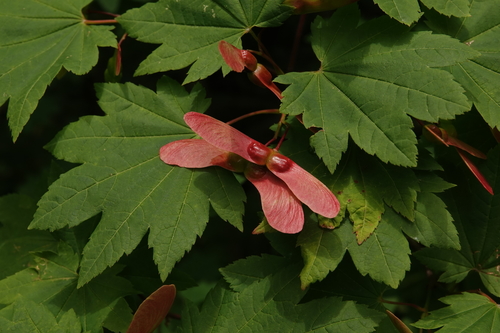
About Acer circinatum Pursh
Scientific name: Acer circinatum Pursh
Description: Acer circinatum, commonly called vine maple, grows as a many-stemmed, shrub-like tree. It most commonly reaches 5 to 8 meters (16 to 26 ft) in height, and may occasionally reach 18 meters (59 ft). It typically grows as a cluster of slender stems 3–10 cm (1–4 in) thick; the trunk of more tree-like specimens can reach 25 cm (10 in) in diameter. Shoots are slender, with smooth, hairless bark.
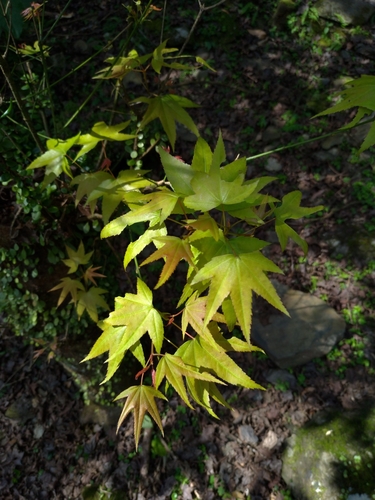
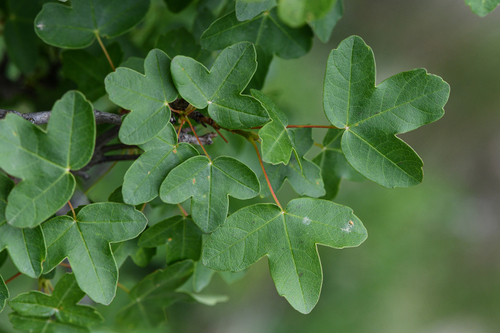
Vine maple leaves are coarsely toothed, 3 to 14 cm (1+1⁄4 to 5+1⁄2 in) long, and palmately lobed with 7–11 lobes. The lobe tips form an almost circular outline, and leaves turn bright yellow to orange-red in autumn.
Vine maple produces single flowers (each flower produces one fruit) that are 6–9 mm (1⁄4–3⁄8 in) in diameter, with dark red sepals and 5 yellow petals. The fruit is a two-seeded winged samara adapted for wind dispersal; each wing is 2–4 cm long, and holds a seed approximately 9 mm (3⁄8 in) in diameter.
Vine maple can reproduce by cloning, when a new shoot develops from an existing root or branch. Occasionally, flexible vine maple branches bend over, grow into the ground, and form natural arches. This cloning method is called layering. It allows vine maple stands to grow quickly, and makes vine maple a successful colonizer during secondary succession after a woodland canopy disturbance.
Distribution and habitat: Acer circinatum occurs from southwestern British Columbia to northern California, usually within 300 km (190 mi) of the Pacific Ocean, specifically along the Columbia Gorge and throughout coastal forests. It is not found inland beyond the east side of the Cascade Range.
Acer circinatum is most often found growing scattered within conifer forests dominated by Douglas fir (Pseudotsuga menziesii), western hemlock (Tsuga heterophylla), and western red cedar (Thuja plicata). Vine maple occasionally establishes small, clonal gaps within conifer forests: it spreads after a canopy disturbance (such as the death of a large tree), and maintains the gap by preventing new large trees from becoming established.
Ecology: Many bird species including nuthatches, chickadees, grosbeaks, warblers, waxwings, vireos, and woodpeckers eat the seeds of this species, as do mammals such as squirrels and chipmunks. Deer and elk browse its foliage, and beavers eat the bark of young vine maple. Vine maple also hosts a variety of epiphytes (non-parasitic organisms that grow on other organisms) including mosses and lichens.
Although vine maple is small compared to the conifers of the forests it inhabits, it is a strong competitor for forest resources. Its fast growth and spread allow it to establish and hold dominance in natural forest clearings, and quickly colonize new canopy openings created when trees die.
Vine maple is an important component of Pacific Northwest forest ecosystems: it cycles nutrients faster than conifers, and creates thinner, more nutrient-rich forest floor layers that support higher biodiversity. Vine maple produces more leaf litter than conifers, and its leaves decompose more quickly. This leads to higher concentrations of nitrogen, phosphorus, calcium, magnesium, potassium, iron, and zinc near the surface of the forest floor.
Cultivation: Vine maple is occasionally cultivated as an ornamental tree outside its native range, with cultivated populations from Juneau, Alaska, and Ottawa, Ontario, to Huntsville, Alabama, as well as in northwestern Europe.
Uses: The Quinault people used vine maple shoots to weave baskets.