About Acentria ephemerella (Denis & Schiffermüller, 1775)
Acentria is a monotypic moth genus (meaning it contains only one species) in the family Crambidae, described by James Francis Stephens in 1829. Its single species is Acentria ephemerella, commonly called the watermilfoil moth or water veneer, which was originally described by Michael Denis and Ignaz Schiffermüller in 1775. This species is used as a biological pest control agent against the invasive noxious aquatic plant Eurasian watermilfoil (Myriophyllum spicatum).
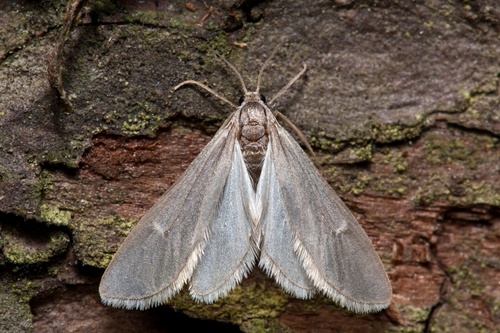
Adult male Acentria ephemerella are white moths with a wingspan of approximately 12 millimeters. Their forewings are whitish, with indistinct brownish coloring along the veins and costa (leading edge of the wing), while their hindwings are entirely whitish. Female moths most often have rudimentary, underdeveloped wings, but in some cases females have larger wings than males, reaching up to 23 millimeters in wingspan. Full-grown larvae are light olive-green with light brown heads. While the extent of wing development in females varies widely between individuals, the conditions that drive this variation are still not understood.
There are two distinct female morphological forms. Most females are flightless, and live either at the water surface or just below it. A small number of females have longer wings and are capable of flight. Acentria ephemerella is an aquatic insect, and the majority of its life cycle is completed underwater. Females are fertilized at the water surface, then dive to lay their egg masses on aquatic plants including pondweeds (Potamogeton spp.), Canadian waterweed (Elodea canadensis), and watermilfoil.
After hatching, larvae bore into plant stems, and glue together pieces of plant material to construct a protective shelter. As they feed, they girdle plant stems, which causes significant damage: affected stems and leaves die or break off from the plant. Larvae pupate inside an underwater cocoon that is filled with air. When adults are ready to emerge, both males and winged females swim up to the water surface and fly away.
Though this moth is used for biocontrol of watermilfoil, its use is carefully managed because it does not have strict host specificity, and will feed on other plant species including native plants. It does tend to prefer Eurasian watermilfoil (M. spicatum) over other plant species. The species is native to Europe, but was discovered in Canada in the 1920s, after likely being introduced accidentally. It is now established across much of the northeastern United States, where it appears capable of reducing watermilfoil infestations.