About Accipiter superciliosus (Linnaeus, 1766)
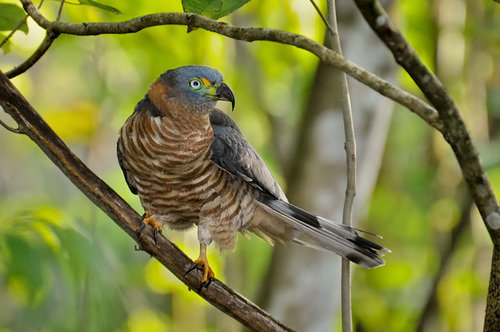
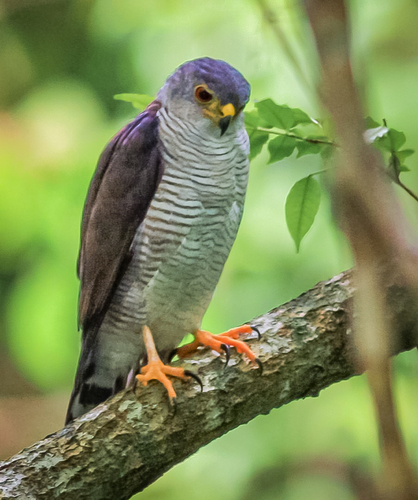
The tiny hawk (Accipiter superciliosus) lives up to its common name: males measure 20 cm (7.9 in), around the size of a starling, while females are slightly larger at 26.5 cm (10.5 in). It is one of the smallest true raptors in the world, and also one of the smallest species in the Accipiter genus; Africa's little sparrowhawk is a similar or even smaller size. Individuals of this species weigh between 75 and 120 g (2.6 to 4.2 oz). As with most raptors, this species shows considerable sexual size dimorphism: females can be up to 25% longer and as much as 60% heavier than males. Adult male tiny hawks are dark slaty gray on their upperparts, with a mottled gray face, a paler gray supercilium, and a blackish crown and nape. Their white underparts are covered in fine gray barring, with the exception of an unmarked throat. Their medium-long tail is dark with three paler gray bands. Adult females have a similar pattern, but are browner on the upperparts, with buffier underparts and darker brown barring on the underside. The cere and legs of tiny hawks of all ages are yellow, and their relatively heavy bill is gray. Adult birds have red or red-brown irises, while the irises of immature birds are often yellowish. Unlike most accipiters, the tiny hawk has a quite short tail that is squared or notched at the tip. Its wings are medium-length with pointed tips, and its legs and toes are long. Immature tiny hawks occur in two color morphs: brown and rufous. Brown morph immature birds are dark sooty-brown on the upperparts, finely barred with black, and white on the underparts, heavily barred with cinnamon. Rufous morph immatures are more chestnut on the upperparts, and barred with rufous (rather than cinnamon) on the underparts. They also have duskier heads and brighter rufous tails than brown morph birds. The call of the tiny hawk is a shrill, high-pitched, somewhat wavering series of 20–30 notes of uneven pitch. After an initial few accelerating notes, the call settles into a steady rhythm, which has been variously transcribed as caucau-ca-ca-ca, keer-keer-keer or kree-ree-ree-ree. Tiny hawks have a patchy distribution ranging from eastern Nicaragua south to western Ecuador, northern Bolivia, northern Argentina, Paraguay and southern Brazil. They most often live in humid and wet lowland forests (including secondary growth) and forested foothills, from sea level up to around 1800 meters (5900 ft), though most recorded observations of the species come from elevations below 1000 m (3300 ft). The species is thought to be fairly sedentary. Like all accipiters, the tiny hawk feeds primarily on birds. It hunts hummingbirds and small passerines, typically darting out from cover to snatch passing birds, but also ambushing smaller birds when they are perched. There is some evidence that tiny hawks learn the regular perches of some hummingbirds and hunt them at these sites. However, the species cannot be classified as a specialized predator of hummingbirds. Some individual tiny hawks also hunt rodents and bats.