About Accipiter striatus Vieillot, 1808
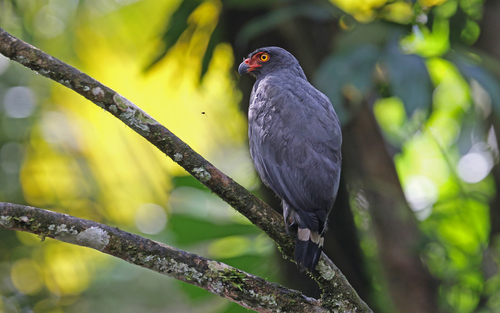
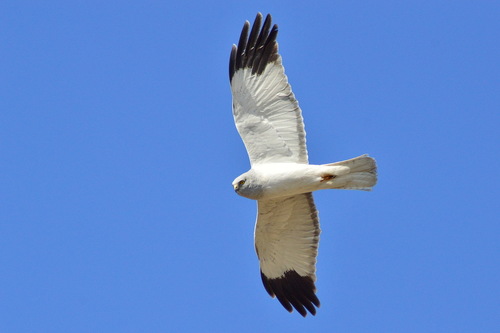
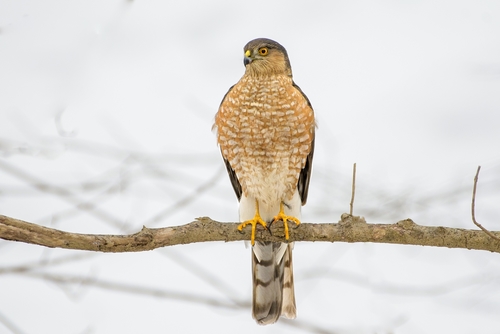
Accipiter striatus, described by Vieillot in 1808, is a small Accipiter hawk. As is common among Accipiter hawks, females are distinctly larger than males: males measure 23 to 30 cm (9.1 to 11.8 in) in length, have a wingspan of 42 to 58 cm (17 to 23 in), and weigh 82–115 g (2.9–4.1 oz), while females average around 30% longer and commonly weigh more than 50% more than males. Females measure 29 to 37 cm (11 to 15 in) in length, have a wingspan of 58 to 68 cm (23 to 27 in), and weigh 150 to 219 g (5.3 to 7.7 oz). For northern group individuals, individual wing length ranges 14.1–22.9 cm (5.6–9.0 in), tail length ranges 12–19 cm (4.7–7.5 in), and tarsus length ranges 4.5–5.9 cm (1.8–2.3 in); these measurements are comparable for other subspecies. Adults have short broad wings and a medium-length tail banded blackish and gray, with the tail tip varying between individuals from slightly notched, to square, to slightly rounded, and is often narrowly tipped white. The flight feathers (remiges), which are typically only visible in flight, are whitish with blackish barring. Its legs are long and very slender (the source of its common name), and yellow. The hooked bill is black, and the cere is yellowish. Plumage varies between the recognized groups. For the nominate group, the cap is dark and the upperparts are blue-grey, with the cap darker. A few more-or-less random white spots are often visible on the scapulars, the feathers that cover the junction of the wing and body. The underparts are white with rufous or tawny bars. The crissum, the undertail coverts surrounding the cloaca, is white. The thighs are rufous, but often barred white. The cheeks have a rufous tinge, which is sometimes faint but generally very distinct in taxa from the Greater Antilles. Adults have dark orange to red irises, while juveniles have yellowish to pale orange irises. Juveniles have dark brownish upperparts, with each feather edged rufous, giving a rather scaly appearance. The juvenile brown head is streaked with white, and the whitish underparts are extensively streaked brown or reddish, usually with reddish barring on the sides. A. (s.) chionogaster, the white-breasted hawk, resembles nominate group members, but has darker upperparts that often appear almost black, whitish-buff thighs, and entirely white underparts and cheeks. Juvenile white-breasted hawks have darker upperparts and distinctly finer streaking on the underparts than nominate group juveniles. A. (s.) ventralis, the plain-breasted hawk, is polymorphic. The most common morph has dark grey upperparts (often appearing almost black) and white underparts that are variably barred, shaded, or mottled with rufous or tawny-buff; extensively marked individuals may appear almost entirely rufous or tawny-buff on the underparts. Occassionally, barring on the lower belly and flanks may appear duskier. The white morph has bluish-grey upperparts, similar to the nominate group, but its underparts are entirely white except for the rufous thighs. The rare dark morph, the only morph that sometimes lacks rufous thighs, is entirely sooty, and occasionally has slight white barring on the belly and faint grey bands on the tail. Among plain-breasted hawks, females of the same morph have paler underparts on average than males. The iris is typically yellow, which contradicts illustrations in some books, though individuals (mainly sub-adults) with darker irises are occasionally seen. Juveniles have dark brownish or dusky upperparts, with each feather typically edged rufous, giving a rather scaly appearance. The juvenile underparts are white streaked brown, and the thighs are rufous barred white. Occassionally, juveniles with underparts extensively rufous streaked blackish are seen. A. (s.) erythronemius, the rufous-thighed hawk, resembles the nominate group, but has darker upperparts, rufous or dusky streaking on the underparts, and typically has a clear rufous patch on the cheeks (which is occasionally almost entirely absent). It has a yellow iris, which contradicts illustrations in some books. Juveniles resemble nominate group juveniles, but underpart streaking is typically restricted to the throat and central underparts, with scaled or barred flanks (and often also a scaled or barred belly). This species is widespread across North America, Central America, South America, and the Greater Antilles. The four main groups, sorted roughly from north to south by distribution, are as follows. The nominate (A. s. striatus) group is widespread across North America, occurring throughout all forested parts of the USA and Canada, and breeding across most of this area. Northern populations migrate south to spend the non-breeding (winter) season in the southern USA, Mexico, and Central America as far south as Panama, with a smaller number wintering in the Greater Antilles. Resident populations exist in temperate parts of the US, a few coastal regions of Canada, Mexican highlands from Sonora to Oaxaca, Cuba, Hispaniola, and Puerto Rico. A. (s.) chionogaster (white-breasted hawk) occurs in highlands from far southern Mexico (Chiapas and Oaxaca), through Honduras, Guatemala and El Salvador, to Nicaragua. As far as is known, it is resident, though some local movements may occur. A. (s.) ventralis (plain-breasted hawk) occurs in the coastal mountains of northern Venezuela and Colombia, and extends south through the Andes from western Venezuela, through Colombia, Ecuador and Peru, to central Bolivia. A separate disjunct population occurs in the Tepuis of southern Venezuela; it is likely to extend into adjacent parts of Roraima in far northern Brazil, but this has not been confirmed. As far as is known, it is resident, though some local movements may occur. A. (s.) erythronemius (rufous-thighed hawk) is widespread in eastern South America, found in eastern and southern Brazil, Uruguay, Paraguay, north-eastern Argentina, and south-eastern Bolivia. As far as is known, it is resident in some regions and migratory in others. Its movements are generally poorly understood, but it only occurs seasonally at some localities in Argentina. This species occurs in a wide range of woodland and forest types, including both types dominated by conifers, and types dominated by various broad-leaved trees (especially oaks). The largest populations of the nominate group are thought to occur in temperate boreal forests, and they winter in warmer regions further south. The taxa A. s. suttoni, A. s. madrensis (both part of the nominate group), the white-breasted hawk, and the plain-breasted hawk are found in upper tropical to temperate highlands, mainly at altitudes of 300–3,000 m (980–9,840 ft), but occasionally occur as low as near sea-level and as high as 4,000 m (13,000 ft). The rufous-thighed hawk is found in tropical and subtropical regions, in both lowlands and highlands. Sharp-shinned hawks build a stick nest in a large conifer or a dense cluster of deciduous trees. Clutches of 3 to 8 eggs have been recorded, but the typical clutch size is 4 to 5 eggs. The eggs measure 37.6 mm × 30 mm (1.48 in × 1.18 in) and weigh about 19 g (0.67 oz). The eggs have heavy, varied, colorful markings. The average incubation period is thought to be around 30 days. After hatching, the female broods the young for 16 to 23 days, while the male defends the territory and catches prey. The young fledge at around one month old, and rely on their parents for feeding and protection for an additional four weeks. Sharp-shinned hawk nesting sites and breeding behaviour are generally secretive, to avoid predation by larger raptors such as the American goshawk and the Cooper's hawk. During migration, adult sharp-shinned hawks are sometimes preyed on by most larger bird-hunting raptors, especially the peregrine falcon. The breeding behaviour of the white-breasted hawk, plain-breasted hawk, and rufous-thighed hawk is comparably poorly known, but based on available information it appears to differ little from the breeding behaviour of the nominate group. In Puerto Rico, some growth stages of invasive boa constrictors may eat sharp-shinned hawks.