About Accipiter ovampensis Gurney, 1875
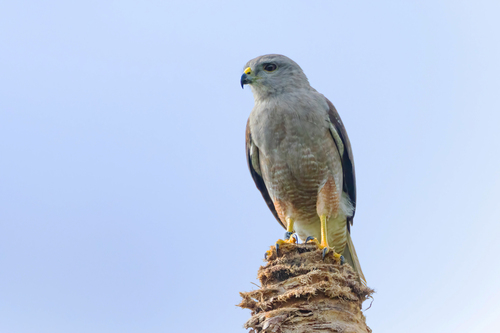
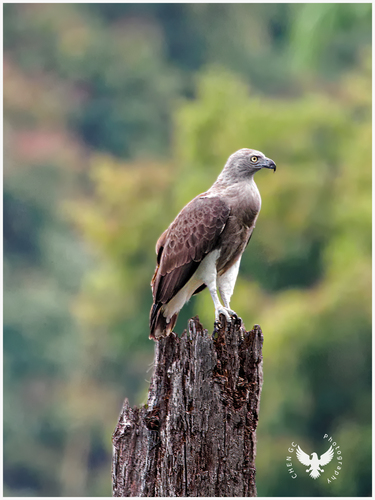
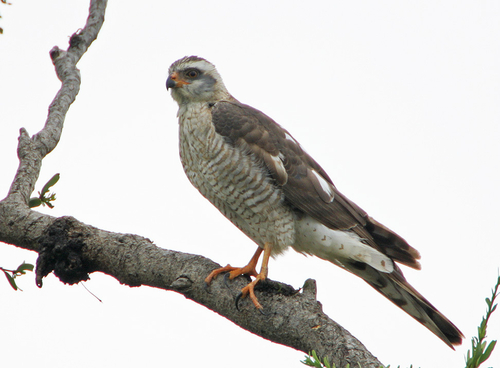
The Ovambo sparrowhawk (Accipiter ovampensis Gurney, 1875) is a small sparrowhawk that has the characteristic broad-winged, long-tailed body shape common to all species in the genus Accipiter. Adult individuals have solid grey upperparts, with white bars on the rump. Their underparts are white, finely marked with grey barring, but the vent is plain white. The tail features three dark bars plus a broad, dark subterminal band. The bill is black, which contrasts with the red cere; the eyes are dark red, and the legs are orange. A melanistic morph exists, which is entirely black except for white-barred flight feathers on the underwing. Juvenile Ovambo sparrowhawks are browner than adults: they may have white underparts and head, or a brown head and rufous underparts. Females are roughly 14% larger than males. Females weigh 180–305 g (6.3–10.8 oz), while males weigh 105–190 g (3.7–6.7 oz). The species has a total length of around 30 cm (12 in), and a wingspan of 67 cm (26 in). This species is found across sub-Saharan Africa, and most breeding populations occur south of the equator. It is a localised and uncommon breeder in East Africa, ranging north as far as Ethiopia and Eritrea, and south to Tanzania. Its main distribution range is in southern Africa, where it extends from the southern Democratic Republic of Congo to northern Namibia, Botswana, northern South Africa, Eswatini and Mozambique. In West Africa, it occurs from the Central African Republic in the east to the Ivory Coast in the west. Birds recorded in the northern parts of the species' range, especially in West Africa, are most likely nomadic non-breeding visitors. Ovambo sparrowhawk generally prefers the edges of drier forest, woodland, and exotic plantations. It also moves into surrounding savanna and tall woodland with patches of open ground, such as riverine woodland and broad-leaved woodland. In southern Africa, its habitat is usually dominated by miombo (Brachystegia spp), Mahobohobo (Uapaca kirkiana) or Zambezi teak (Baikiaea plurijuga).