About Acasis viretata (Hübner, 1799)
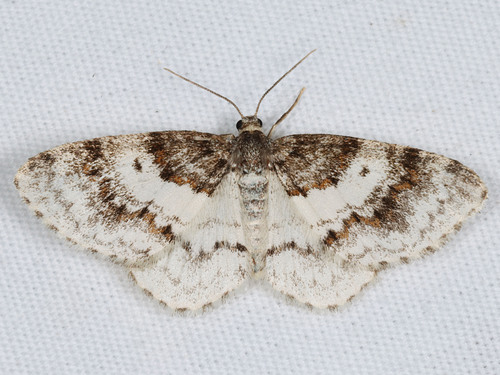
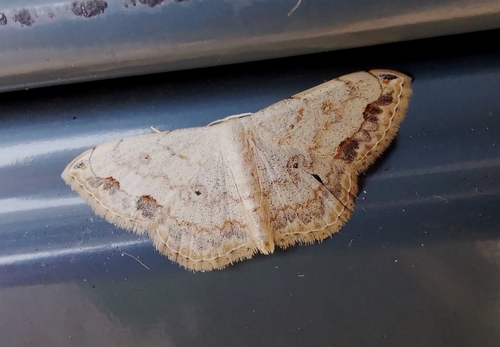
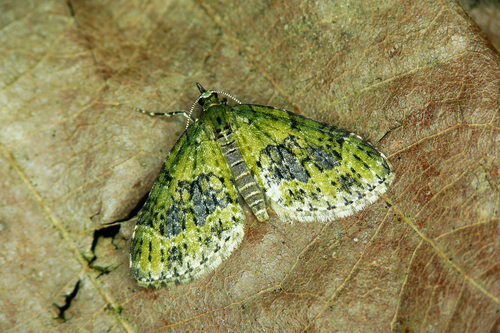
Acasis viretata, commonly known as the yellow-barred brindle, is a moth species belonging to the family Geometridae. The species was first formally described by Jacob Hübner in 1799. This moth can be found across most of Europe, and extends throughout the Palearctic region all the way to Korea. In northern India, the subspecies Acacis viretata himalayica (Prout, 1958) occurs. The species is also present in North America. It occupies a wide range of different habitats, including deciduous forests, mixed forests, rocky slopes, valleys, bushy meadows, bogs, and taiga areas. In the Alps, it can be found at elevations up to 1700 meters. The wingspan of adults ranges from 25 to 29 millimeters. This is a slender, grey-green moth; its green coloration fades quickly, so older specimens typically appear yellowish. The forewing is yellowish olive-green, with a broad grey transverse band across its middle that has wavy inner and outer edges. Along the outer edge of the forewing runs an interrupted white band marked by small black double spots, which is a characteristic identifying feature of the species. The hindwing is relatively small, has long hair fringes, and is silky greyish-white in color. The caterpillar of Acasis viretata is green, with a more or less pronounced pinkish tinge. It has three interrupted pink lines along its back; the central line sometimes leans toward purple, and is broken into large heart-shaped spots that range from wine-red to red. The caterpillar's head is brown, sometimes marked with purple, and two tiny points are present on its last body segment. Caterpillars vary in both the intensity of their green base color and their markings. In western Europe, adults are active on the wing from mid-April to October, and produce two generations per year. The larvae feed on a wide variety of plant species, including Rhamnus frangula, Hedera helix, Ligustrum, Ilex aquifolium, Cornus sanguinea, and Sorbus aucuparia.