About Acarospora socialis H.Magn.
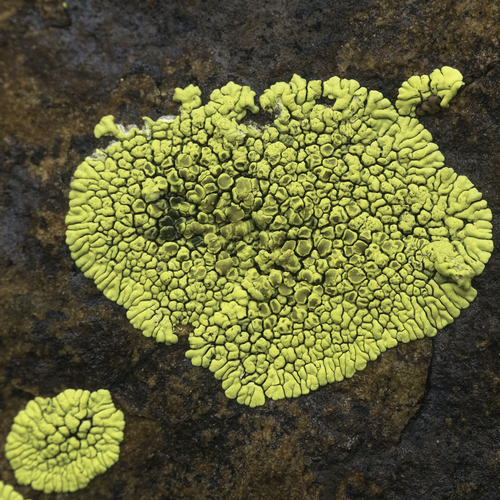
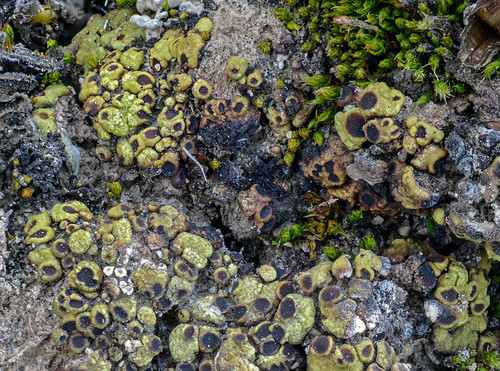
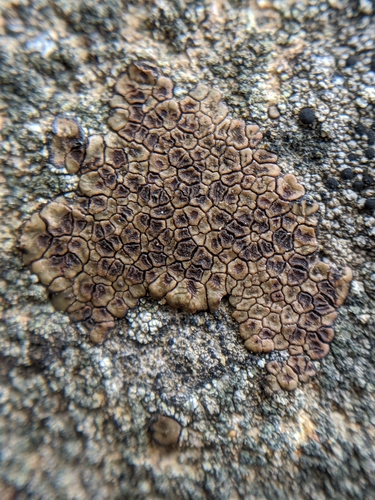
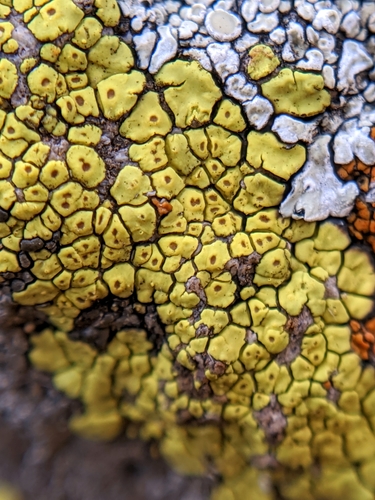
Acarospora socialis, commonly known as bright cobblestone lichen, is a typically bright yellow areolate to squamulose crustose lichen belonging to the family Acarosporaceae. It grows up to 10 cm wide, and occurs mostly on rock in western North America. It is one of the most common lichens found in the deserts of Arizona and southern California. It grows on sandstone, intrusive and extrusive igneous rock such as granitics, and tolerates all levels of sun exposure, including on vertical rock walls. Its distribution in North America ranges across the Mojave Desert and Sonoran Desert region, extending to Baja California Sur. It is the most common yellow species of its genus in southwestern North America. Rarely, it sometimes grows on other soil crusts. It is a pioneer species, and has a variable growth pattern. Its areoles can be angular or round, and sometimes develop lobes. Areoles may grow either contiguous to each other or scattered across the substrate. The color of this lichen is variable, including bleached white, green-yellow, and other shades of yellow. When it grows in a squamulose form, it has a lower surface, but lacks a lower cortex. With age, it develops stipes. Outside of desert habitats, each squamule contains 0 or one 1 mm round to angular immersed apothecia; in desert habitats, squamules may hold 2 to 10 apothecia each. Two apothecia may merge, leaving a peninsula (umbo) of thalline tissue through the apothecial disc. Apothecia may have lecanorine margins, and have a flat to concave, mostly brown or reddish brown, concave disc. All lichen spot tests for this species are negative. It tests UV+ orange. Its secondary metabolites include rhizocarpic acid, and sometimes trace amounts of epanorin. When young, it closely resembles Acarospora contigua, but A. socialis develops areolas that become lobed and squamulose. When growing on soil, it may be misidentified as Acarospora schleicheri, but A. socialis has contiguous areoles, while the areoles of A. schleicheri can be imbricate. It is also similar to Acarospora chrysops, a species that grows from South America to central Mexico, through Texas and into the Rocky Mountains. It closely resembles Pleopsidium flavum at mid-level mountains; Pleopsidium flavum favors higher elevations above 900 metres (3,000 ft), is somewhat effigurate, and produces smaller yellow apothecia less than 1 mm in size.