About Acanthurus triostegus (Linnaeus, 1758)
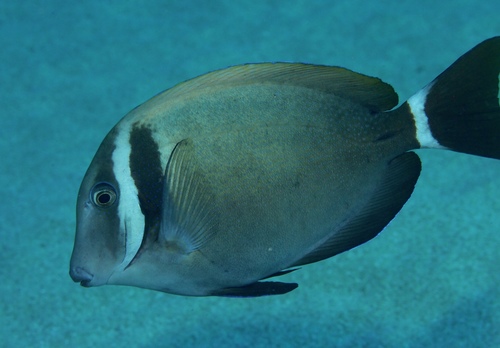
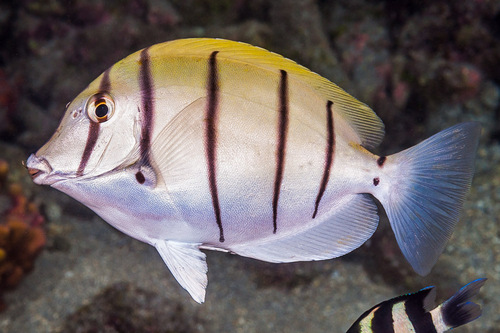
The convict tang (Acanthurus triostegus) gets its common name from its bold black stripes set against a yellowish body background. This species is an oval-shaped, laterally compressed fish with a maximum total length of approximately 26 to 27 centimeters, or 10 to 11 inches. It has a small head, a pointed snout, and a terminal mouth lined with thick lips. Convict tangs have six black stripes, a feature that distinguishes them from the closely related zebra tang (Acanthurus polyzona), which has nine black stripes and a more restricted distribution within the Indian Ocean. On the convict tang, the first black stripe is angled obliquely and runs directly through the eye. The convict tang has two black spots on its caudal peduncle, and one sharp, retractable spine sits on each side of this structure; these spines are used for both offensive and defensive purposes. Acanthurus triostegus is native to the tropical Indo-Pacific region. Its native range extends from the East African coast and Madagascar eastward to southwestern Japan, Australia, and Central America, and includes many Pacific island groups. This species lives over hard substrates in habitats including lagoons, reef slopes, bays, and estuaries. Young juvenile convict tangs are commonly found in tide pools, while larger adult individuals occur at depths down to around 90 meters, or 300 feet.