About Acanthurus thompsoni (Fowler, 1923)
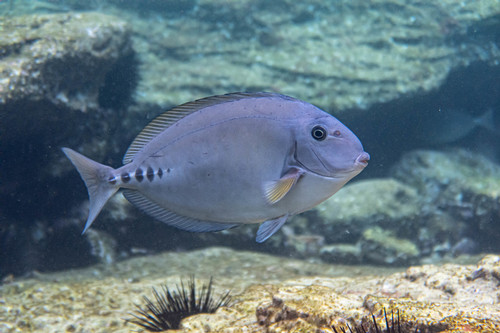
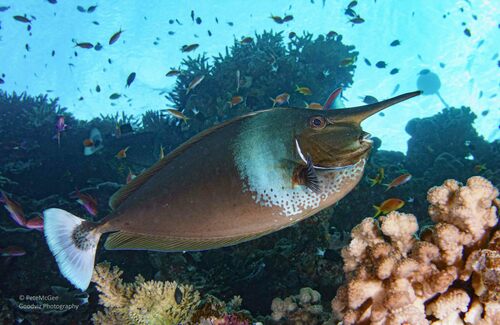
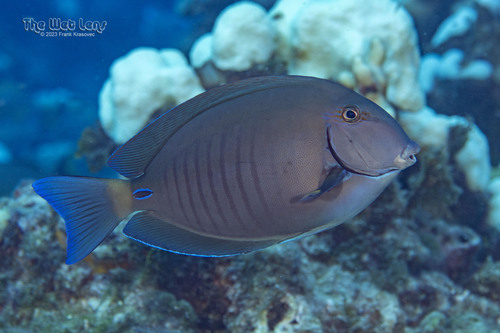
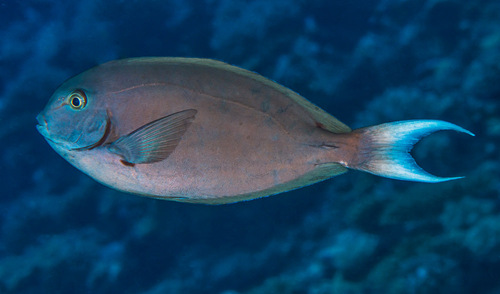
Acanthurus thompsoni (Fowler, 1923) has a dorsal fin supported by 9 spines and 23 to 26 soft rays, while its anal fin is supported by 3 spines and 23 to 26 soft rays. The pectoral fins of this species have 17 fin rays. Adult individuals have 20 or 21 teeth in the upper jaw and 24 teeth in the lower jaw. The body is oblong, with a depth that measures less than half of its standard length. The dorsal profile of the head is distinctly convex, and the snout is short. The maximum published total length for this species is 27 cm (11 in). Its overall body color is uniformly brown, with a white caudal fin and a small dark spot located behind the base of the pectoral fin. Acanthurus thompsoni has a wide distribution across the Indo-Pacific region. It is not found in the Red Sea, and occurs along the eastern coast of Africa from the Gulf of Aden south to Sodwana Bay in South Africa; its presence in Somalia has not been confirmed. It ranges east across the Indian Ocean into the Pacific Ocean as far east as the Pitcairn Islands and Hawaii, south to the Great Barrier Reef and New Caledonia, and north to Kochi Prefecture in southern Japan. Within Australian waters, this species is found at Christmas Island, the Cocos (Keeling) Islands, Rowley Shoals, Scott Reef, Ashmore Reef, the northern Great Barrier Reef, and reefs in the Coral Sea. This species has been recorded in waters as deep as 75 m (246 ft), but it is most commonly found at depths of less than 30 m (98 ft). It inhabits sandy and coral areas in clear water on steep drop offs and outer reef slopes.