About Acanthurus tennentii Günther, 1861
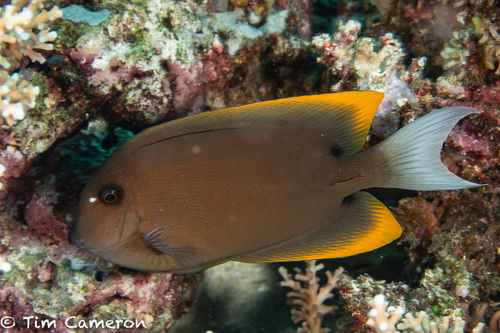
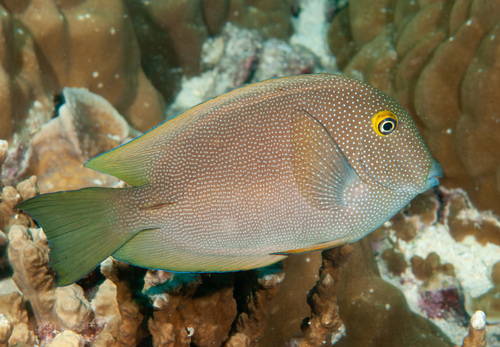
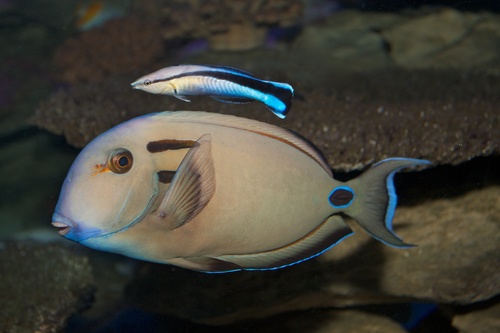
Physical Description: The Doubleband Surgeonfish (Acanthurus tennentii Günther, 1861) is a deep-bodied, laterally compressed oval-shaped fish, with a body depth that is more than half its body length. This species grows to an average length between 25 cm (10 in) and 31 cm (12 in). Males and females have similar appearance outside of breeding season; during breeding season, mature males develop more vibrant coloration or darker streaks to attract mates. Base body coloration varies across individuals, ranging from orange-beige, olive-tan, to steely grey, and can shift to a dark brown shade with subtle red or purple hints when the fish is stressed. A dark line runs along the base of the dorsal fin, with an identical matching dark line along the base of the anal fin. Two distinct dark streaks are located behind the eye. Black, scalpel-shaped modified scales project from the fish's caudal peduncle, and this structure is surrounded by a large black spot edged with a bluish border. Both the dorsal and anal fins are long, extending all the way to the caudal peduncle. The caudal fin is crescent-shaped, and its lobes grow longer as the fish ages. The entire caudal fin is rimmed with a bluish-white band. Distribution and habitat: This species has a broad distribution across the tropical and subtropical Indo-Pacific, ranging from East Africa and Madagascar east to Southeast Asia, including Sri Lanka, Malaysia, Thailand, and Indonesia. It primarily inhabits rocky and coral reef environments, including reef slopes and channels between reefs. It is most commonly found at depths between 1 and 40 meters (3 to 131 ft), and prefers water temperatures between 25 and 29°C. Reproduction: Doubleband Surgeonfish reproduce through external fertilization. Females move to the reef surface to release eggs, and males follow behind the females to release sperm in response. After the eggs are fertilized, the resulting larvae drift freely in the water column throughout their planktonic developmental stage. Around seven weeks after hatching, the larvae return to reef habitats to settle. The breeding season typically runs from July to August, and cyclical physical changes in preparation for breeding begin around April each year. Ecology: The Doubleband Surgeonfish feeds on algae growing on the seabed, detritus, and the thin algal film that grows on sand and other substrates. Juvenile individuals typically join mixed-species social groups with other fish species. Juveniles start out either solid black, or yellow with a black horseshoe-shaped ring around the eye, and later develop an appearance similar to adult fish, except for differences in the dark markings behind the eye. This species is diurnal, feeding in open areas during the day, often in small groups alongside parrotfish and other fish species.