About Acanthurus nigroris Valenciennes, 1835
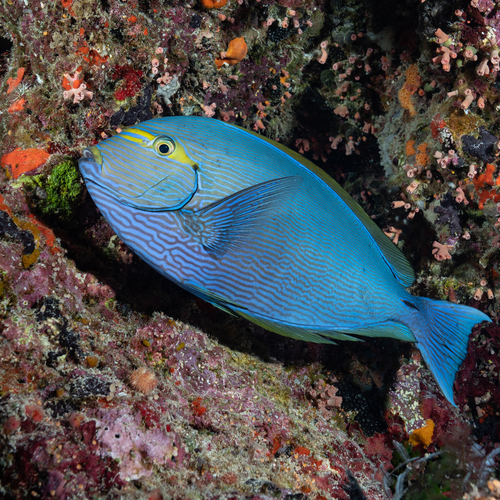
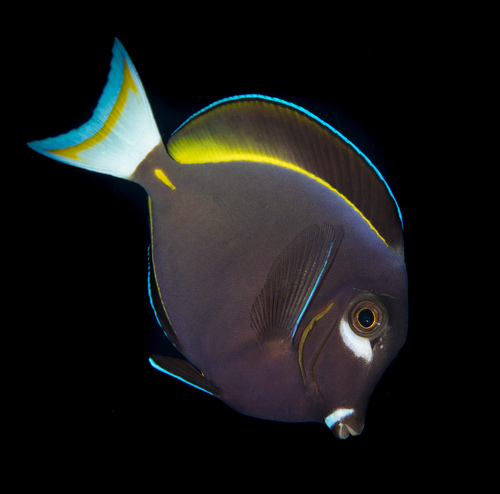
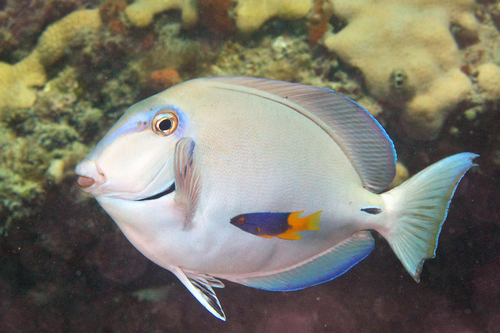
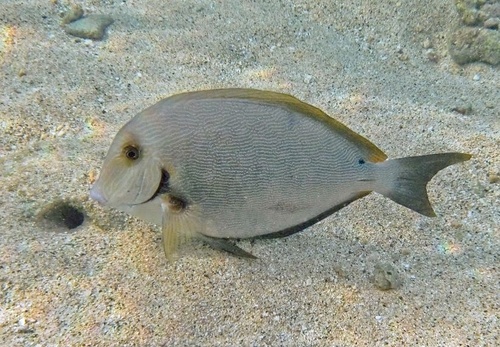
Acanthurus nigroris has 9 spines supporting its dorsal fin, which also has between 23 and 26 soft rays. Its anal fin is supported by 3 spines and between 22 and 24 soft rays. This species has between 26 and 31 anterior gill rakers. The body overall ranges in color from pale to dark brown, and has slightly irregular, horizontal dotted blue lines that are thinner than the brown spaces between the lines. Blue lines run parallel to the snout on the head below the eye and on the gill cover. There is a black spot, with a diameter less than half the diameter of the eye, at the posterior end of both the dorsal and anal fins. A thick whitish bar is frequently present on the caudal peduncle. The dorsal and anal fins have horizontal reddish brown bands and a slender blue margin. The caudal fin has a thin white rear margin. The maximum recorded standard length of Acanthurus nigroris is 18 cm (7.1 in). In terms of distribution and habitat, Acanthurus nigroris sensu stricto occurs in the central Pacific Ocean, and is only known from the Hawaiian Islands and Johnston Atoll. This is a generalist species when it comes to habitat; it forms schools ranging from a few individuals to hundreds of individuals, and these schools are found in lagoons, on seaward reefs, and in areas with a mixture of sand, rock, and coral rubble. In these habitats, the fish graze on filamentous algae and feed on plankton.