About Acanthurus nigricauda Duncker & Mohr, 1929
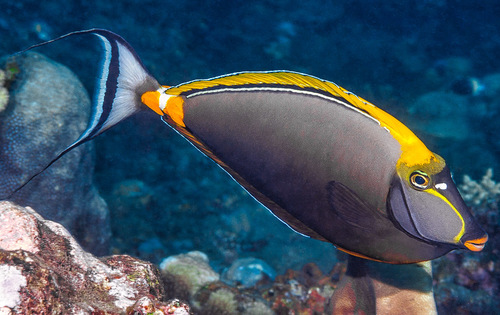
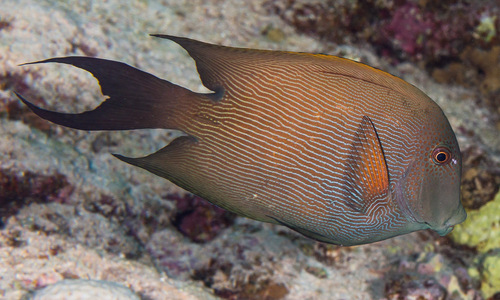
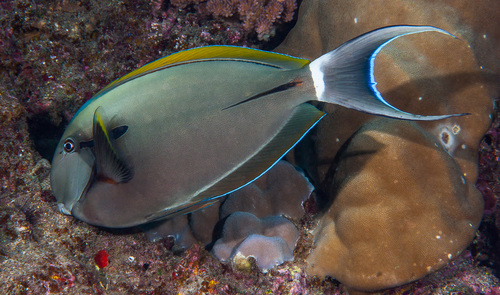
Acanthurus nigricauda Duncker & Mohr, 1929 is a deep-bodied, laterally compressed fish that reaches a maximum total length of 40 cm (16 in). This species has a convex head profile, fairly prominent eyes, and two pairs of nostrils positioned just in front of the eyes. Its dorsal fin has 9 spines and 25 to 28 soft rays, while the anal fin has 3 spines and 23 to 26 soft rays. The caudal fin is crescent-shaped. Tiny scales cover the entire body, giving it a smooth appearance, and its lateral line is indistinct. The head of this fish is usually paler than its body; the body itself is a uniform tone that varies in color from pale grey to dark brown or nearly black, changing based on the fish’s mood. There is a distinct bold black streak called the “epaulette” behind the eye, which extends to the operculum, and a thin black line in front of the pair of sharp scalpels on the fish’s caudal peduncle. The dorsal fin is yellowish, with a black line at the margin that has a blue edge, and the anal fin is grey with a blue margin. The pectoral fins have an orange base, and are banded with grey, yellow, and translucent tissue; the caudal fin has a white base and a dark outer portion bordered with blue. A. nigricauda can be told apart from the similar doubleband surgeonfish, Acanthurus tennenti, by the single epaulette behind its head. Acanthurus nigricauda is found in tropical and subtropical waters of the Indian Ocean, as well as the western and central Pacific Ocean. Its known range stretches from East Africa and Madagascar to the Tuamoto Islands, and from southern Japan to northern and eastern Australia and New Caledonia. It lives over sandy and rocky substrates in bays, lagoons, and on reef slopes, at depths down to approximately 30 m (100 ft). Unlike most other members of its genus, it is rarely found over coral. Acanthurus nigricauda is a schooling fish that forms shoals, and sometimes associates with the orange-band surgeonfish Acanthurus olivaceus. It feeds by grazing on algal film that grows across sandy areas adjacent to coral or rock substrates. The proportion of algae in the species’ stomach contents is low, and it mostly feeds on organic detritus trapped in this algal film. This species has separate sexes, and both sexes reach sexual maturity at a length of roughly 15 cm (6 in). Large groups of this fish gather during the breeding season, when both sexes release their gametes into the open water column. The scalpels on the caudal peduncle are retractable and very sharp; they are displayed when the fish thrusts its tail to the side, and are used to slash at rival fish and for defense against predators. Juvenile A. nigricauda are shorter and have deeper bodies than adult fish. They are deep brown when young, with a yellowish, unnotched caudal fin, and gradually change color as they grow to between 5 and 10 cm (2 and 4 in) in length.