About Acanthurus monroviae Steindachner, 1876
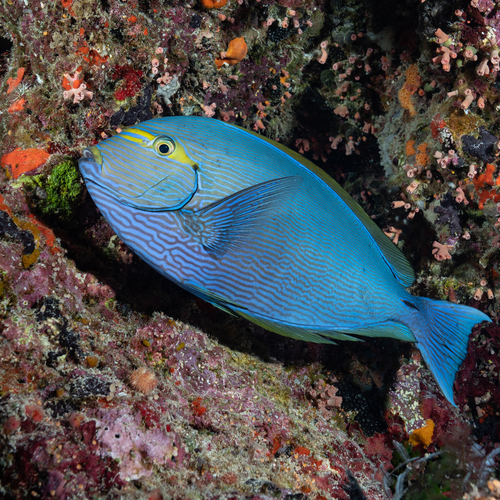
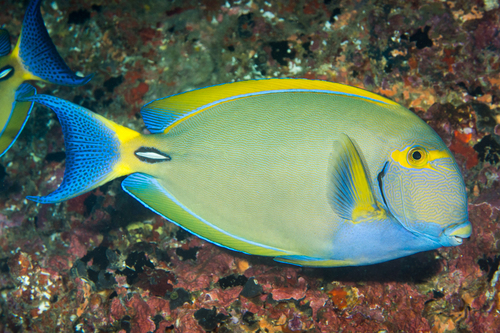
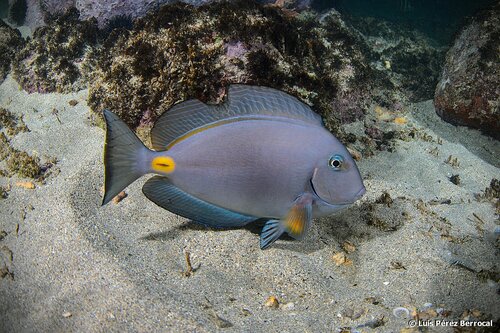
Acanthurus monroviae has a dorsal fin supported by 9 spines and 24 to 26 soft rays, while its anal fin is supported by 6 spines and 24 to 26 soft rays. The body is oval and laterally compressed, with an overall brown base color. This brown coloration is broken by an orange-yellow patch surrounding the spine on the caudal peduncle. In living individuals, many wavy, horizontal light blue lines are present across the head and body. The upper margin of the operculum is yellow, and the caudal fin is lunate with a whitish rear margin. The maximum published standard length for this species is 45 cm (18 in). In terms of distribution and habitat, Acanthurus monroviae occurs in the tropical eastern Atlantic Ocean, ranging from southern Morocco to Angola, and including the Canary Islands, Cape Verde, and the Gulf of Guinea. It has been recorded rarely in the Mediterranean Sea since 1987, and vagrants have also been reported off the coast of Brazil. It is a coastal fish found at river mouths and in lagoons with rock and coral substrates, at depths between 5 and 500 m (16 and 1,640 ft). This species feeds on zooplankton, phytoplankton, and detritus.