About Acanthurus coeruleus Bloch & Schneider, 1801
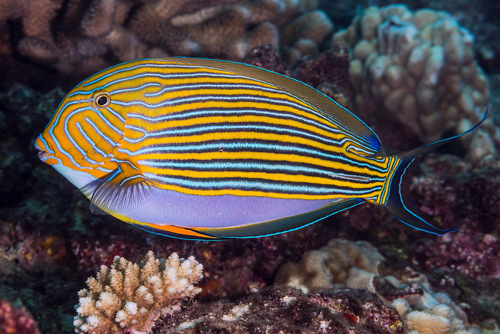
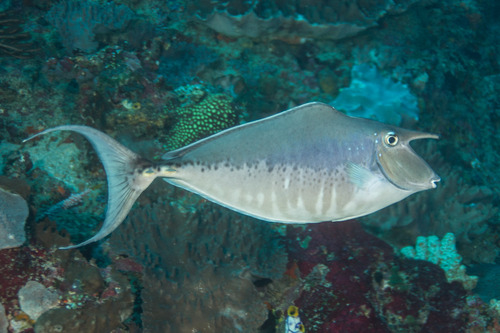
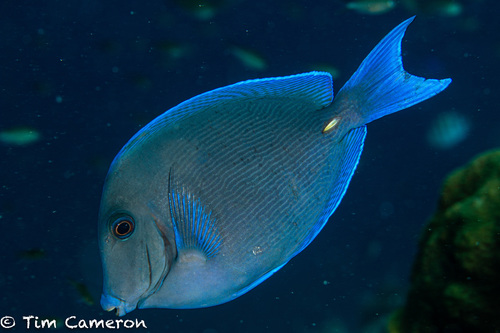
This reef fish, Acanthurus coeruleus, has a body that ranges in shade from light to dark blue, while its dorsal, anal, and caudal fins are golden blue. Juveniles have purple-blue, blue, or blue-green edges on their dorsal and anal fins, and purple-blue, blue, or blue-green rings around their eyes. The species changes color as it grows: it starts as a yellow juvenile, becomes a yellow-tailed blue subadult, and ends as a fully blue adult. Acanthurus coeruleus is biofluorescent: when exposed to blue or ultraviolet light, it re-emits the light as green, which makes it appear different than it does under white light. Biofluorescence may help the species with intraspecific communication and camouflage. Acanthurus coeruleus is distributed in the western Atlantic Ocean from New York to Florida, Mexico, and Brazil, as well as at Ascension Island in the Mid-Atlantic. It has also been found in the Mediterranean Sea since 2011. For blue tangs (Acanthurus coeruleus), food distribution, density, and accessibility determine population density and territory size. Territories with low biogenic structure are larger than territories with higher biogenic structure. Since algal food resources are less dense in areas with low biogenic structure, territories need to be larger to contain enough food, which matches the predictions of the Ideal free distribution model. This model states that competing individuals should adjust their distribution based on habitat quality so that every individual gains the same amount of resources. Following the model, blue tang density is lower on low-biogenic structured territories than on high-biogenic structured territories that hold more abundant food. In both territory types, each individual gets a similar amount of resources because of competition. There is no significant difference in blue tang feeding rates between the two territory types, meaning individuals in larger, low-density, low-biogenic territories gain the same amount of resources as those in smaller, high-density, high-biogenic territories.