About Acanthurus achilles Shaw, 1803
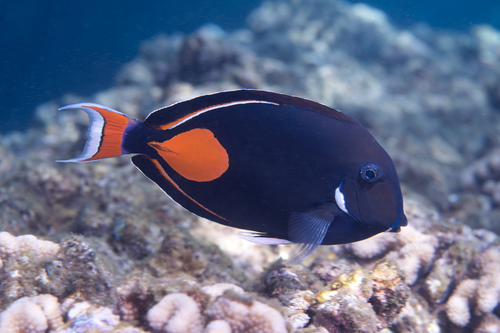
Acanthurus achilles, first described by Shaw in 1803, has an elongated oval-shaped body with a steep dorsal head profile. Its small, protrusible mouth sits low on the head, with 8 to 28 fixed teeth on each jaw; each tooth has a flattened, serrated tip. The dorsal fin is supported by 9 spines and 29 to 33 soft rays, while the anal fin contains 3 spines and 26 to 29 soft rays. A single mobile spine sits on each side of the caudal peduncle, and can fold down into a slit. The caudal fin is concave. The species' overall body color is bluish-black, with an irregular oval orange blotch on the rear of the body, a white bar on the gill cover, and a wide orange bar on the caudal fin which also has a white posterior margin. A pale blue ring runs just inside the tip of the snout. This species reaches a maximum total length of 24 cm, or 9.4 inches.
Acanthurus achilles occurs across a range of reefs in Oceania, reaching as far north as the Hawaiian Islands and as far east as the Pitcairn Islands. It is also found, though less commonly, in the Mariana Islands, and on some reefs off southern Mexico and Guatemala. It is a benthopelagic species that lives in clear waters on the seaward side of reefs.