About Acanthoxyla prasina (Westwood, 1859)
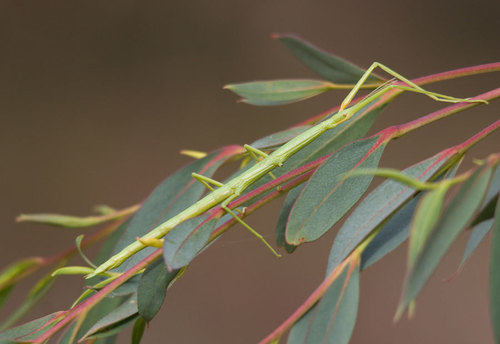
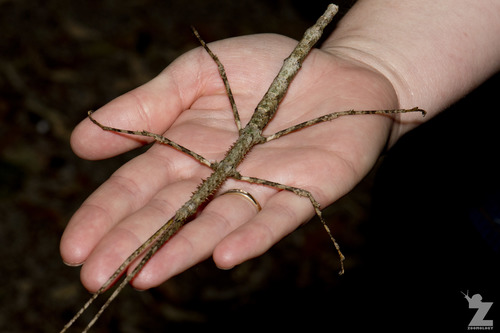
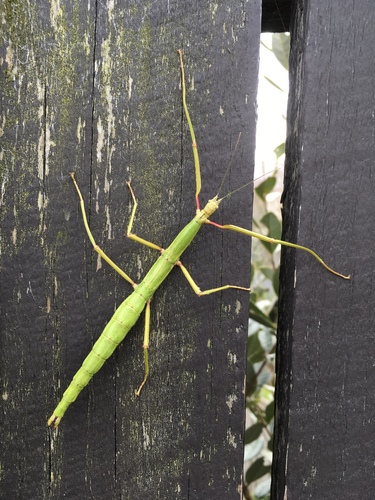
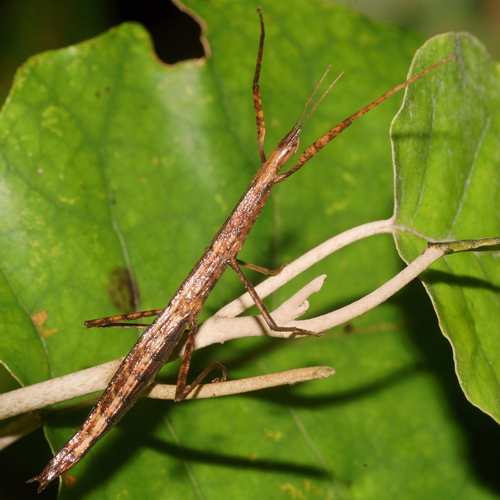
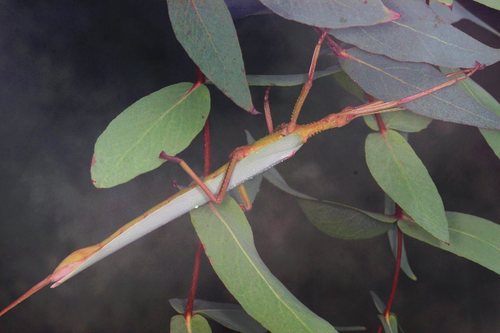
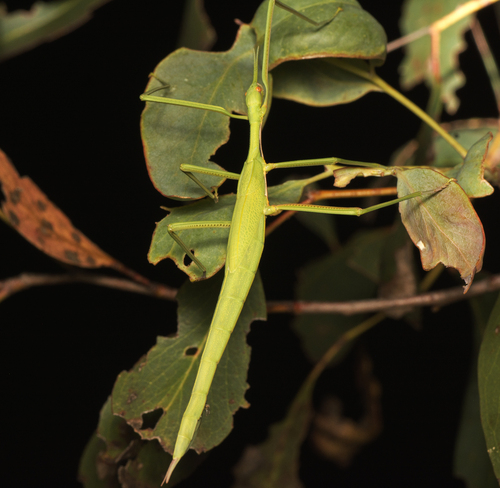
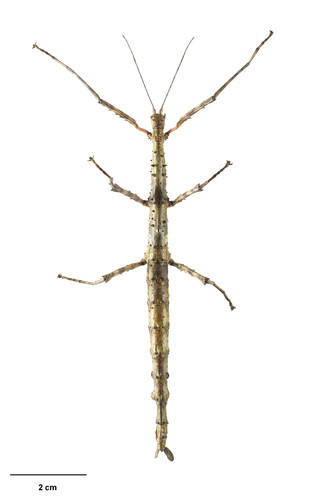
Adult Acanthoxyla prasina are relatively large, with body lengths ranging from 7.5 to 11 cm. Compared to other New Zealand stick insects, they are usually broader, and individuals occur in either green or brown colour forms. Eight subspecies of this species have been described; some of these subspecies have prominent dark spines on the thorax and abdomen. The species displays variation in the number and size of its characteristic spines, including a distinctive projection located under the abdomen at the base of the subgenital plate. Spines with black tips are found across the head, thorax, abdomen, and femora. The antennae are typically slightly longer than the fore femora, and the terminal segment of the abdomen is shorter and more rounded than it is in related species. These physical traits, alongside cryptic body colouring and behaviour, give the species effective protection against predators. This species is endemic to New Zealand, where it is widespread across both native and modified habitats. A. prasina was accidentally introduced to Paignton, United Kingdom, around 1910. Some published reports have misidentified these introduced populations as other Acanthoxyla subspecies, or as the smooth stick insect Clitarchus hookeri. Until recently, all known members of the entire Acanthoxyla genus were female. In 2016, a single male was discovered in Cornwall; this was the first male recorded for any Acanthoxyla species, and it is thought to be a rare mutation. Acanthoxyla prasina populations consist entirely of females, and the species reproduces through parthenogenesis, a form of asexual reproduction. Its eggs measure approximately 4.2 mm by 1.8 mm, are brown-grey in colour, and are covered with fine spines. Females drop their eggs onto the ground, where the eggs stay dormant through winter and hatch in spring as temperatures increase. Even though a single female can lay hundreds of eggs over her lifetime, up to 99% of these eggs do not hatch successfully. Newly hatched nymphs are around 2 cm long. They moult five or six times over roughly six months before reaching maturity; they usually shed their skin at night and consume the shed skin afterwards. Individuals in the genus Acanthoxyla typically live between one and two years.