About Acanthosicyos horridus Welw.
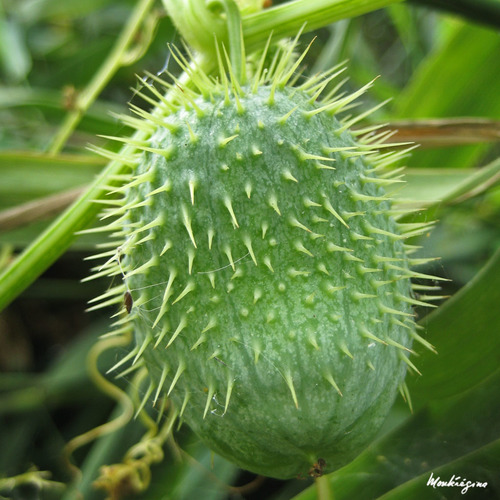
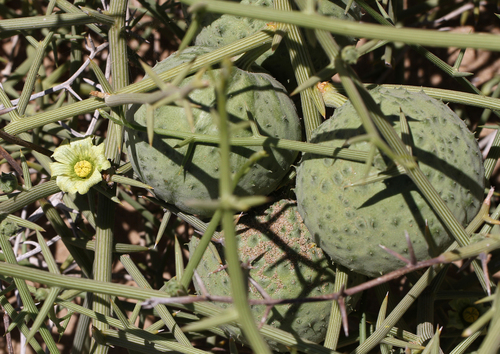
Acanthosicyos horridus Welw. is a dioecious, leafless phreatophyte, meaning its roots penetrate deep to reach water near the water table. This species grows in sandy deserts, not on stony plains, in areas that have access to groundwater such as ephemeral rivers and paleochannels. Sand that accumulates in the shelter of the plant's stems forms hummocks that can reach 1000–1500 m² in area and 4 meters in height. Stems may grow more than a meter above these hummocks, while the plant's system of thick taproots can extend up to 50 m downward. Because the plant is leafless, modified stems and 2–3 centimeter long spines act as its photosynthetic organs. The plant can survive for many years without water. In terms of ecology, the sand-binding characteristics of nara (the common name for this plant) help it form microclimates within desert dunes. These microclimates provide food and shelter for a variety of vertebrates. The presence of the nara plant is linked to significantly increased soil microdiversity; this is likely due to the shade the plant provides, and foraging mammals attracted to the plant that add organic matter to the soil. Acanthosicyos horridus typically grows where no other vegetation is present, because of the harsh local climate, though the grasses Eragrostis spinosa and Stipagrostis sabulicola may grow between its hummocks. It is considered a keystone species: its melons, seeds, shoots, and flowers are food sources for beetles, gemsbok, and ostrich, while small rodents including Rhabdomys pumilio, Desmodillus auricularis, and Thallomys nigricauda take shelter in the tangled spiny mass of its stems. The katydid Acanthoproctus diadematus feeds on this plant, moving between different individual bushes at night. Black-backed jackals locate its ripe melon fruits, and use their jaws to bite through the fruits' tough skins. The chewing molars of canids make them ideal agents for endozoochorous dispersal of the plant's large seeds. This dispersal occurs over long distances of 7–15.9 km. Jackals urinate on buried fruits and return to them later; this behavior is thought to either mark the fruits as their own, or mask their scent from rival jackals. Seeds taken from jackal droppings germinate better than seeds extracted directly from ripe fruit. Additionally, seeds from jackal scats may be collected by scatter-hoarding gerbils, which move the seeds into new microhabitats, dispersing them further and improving their chances of germination. While other carnivores eat other types of fruit, this appears to be the first recorded case where carnivores act as the primary dispersers of a plant's seeds. For human uses, the melon fruits of Acanthosicyos horridus average 1 kg in weight, and are pale green and covered in spines. Inside, they have a sweet, aromatic, watery yellow-orange pulp. The plant produces large edible seeds that are white to cream in color; these seeds are called butter-nuts or butterpips. The seeds have been exported for use in baked goods. The fruit is also a traditional food source for the Nama people, eaten between February and April, and again between August and September.