About Acanthosepion pharaonis (Ehrenberg, 1831)
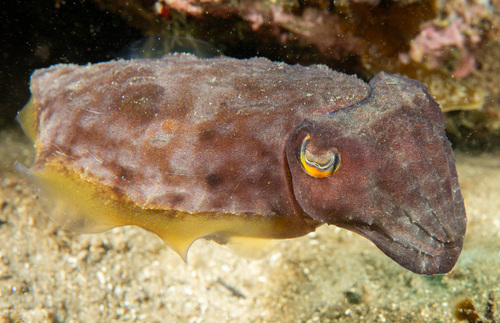
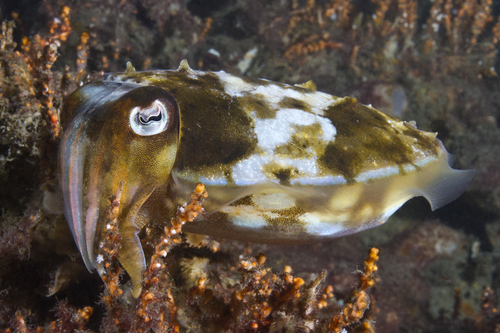
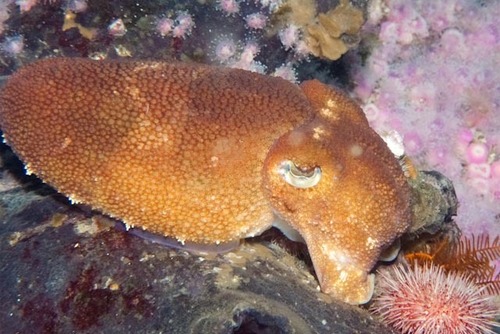
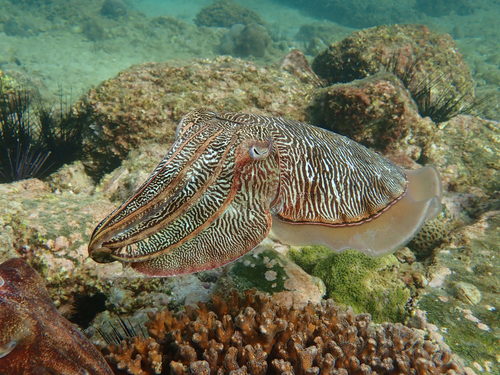
Pharaoh cuttlefish (Acanthosepion pharaonis) commonly display a solid uniform color when resting on a solid-colored background, shifting between pale white and fully dark brown. They can also produce a mottled pattern of white and brown that features a central brown circle. The color-changing mechanism of the Pharaoh cuttlefish is nearly identical to that of other cuttlefish. This ability comes from groups of red, yellow, brown, and black pigmented chromatophores that sit above a deeper layer of reflective, blue- and green-tinted iridophores and leucophores. These specialized pigment cells can reach densities of up to 200 per square millimeter. Each pigment-containing sac is surrounded by a ring of muscle, and the cuttlefish expands or contracts these muscle rings to display different colors. The Pharaoh cuttlefish is native to at minimum the western Indian Ocean, including the Red Sea and Persian Gulf. It is the most frequently caught cuttlefish species in the Persian Gulf. When hunting at night, it moves into shallower coastal waters to feed on a range of smaller fish, crabs, and occasionally other cuttlefish. It is believed to have entered the Mediterranean Sea as a Lessepsian migrant through the Suez Canal, after many of its cuttlebones washed up on Israeli beaches in the early 2000s. Migratory behavior has been recorded for this species off the south-west coast of India. They are most often found furthest north in August, and further south in May, with an even distribution across the region in October and February. More juveniles are present in May, while more adults are present in August. During the day, Pharaoh cuttlefish choose den locations that have medium to high sunlight levels. They also prefer to rest on mud substrate during the day, and will use either sand or mud substrate for activity at night. Like most cephalopods, cuttlefish use their two elongated tentacles to hunt prey, and typically follow a three-stage process of attention, positioning, and seizure. Most adult and juvenile Pharaoh cuttlefish start the attention stage by arranging their arms and tentacles into a triangle shape and turning toward their prey. Next, during the positioning stage, they slowly move their tentacles out from the center of the triangle as they approach the prey. The process ends with the seizure phase: the cuttlefish moves closer before rapidly lunging its tentacles to grab the prey, then retracts the catch back toward its body. Because Acanthosepion pharaonis has a small, stocky body and cannot achieve high forward propulsion speed, it has adapted to use this ambush-style tentacle lunging for hunting. Pharaoh cuttlefish reproduce in a pattern similar to most other cuttlefish. Large males compete with one another, and contests often end without physical combat. Males circle each other, performing threatening displays with color changes and tentacle movements until one male retreats in defeat. The winning male mates with females by grabbing the female with his tentacles, turning her so the pair face each other, then using a specialized tentacle to insert sperm sacs into an opening near the female's mouth. The male then guards the female until she lays her fertilized eggs a few hours later. Females follow a sequence of stages when laying eggs. They first hold a temporary posture with their arms bunched into a fist-like shape, then extend their arms forward, vent water onto the spawning ground and eggs through their funnels, and finally extend their arms to place the laid eggs onto the appropriate substrate. The Pharaoh cuttlefish is a commonly fished cuttlefish species in the Philippines, and it is the most economically important cuttlefish in the northern Indian Ocean, where it is regularly consumed by humans. Dried shredded cuttlefish, a popular snack food, is typically made from this species. A Qing Dynasty Chinese gastronomy manual called the Suiyuan shidan lists cuttlefish roe as a difficult-to-prepare but highly sought-after delicacy. This species is also commercially harvested by fishermen in the Suez Canal, Egypt. Ink from this cuttlefish was historically used to make the dye sepia, an important natural pigment that has now been largely replaced by artificial dyes.