About Acanthorhynchus tenuirostris (Latham, 1801)
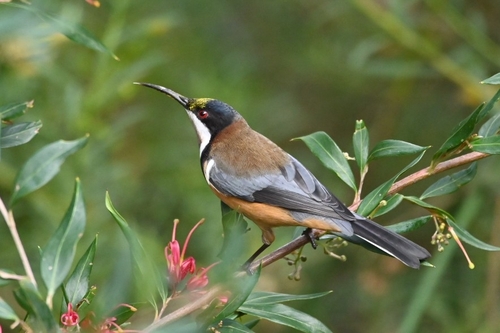
The male eastern spinebill (Acanthorhynchus tenuirostris) measures 13–16 cm (5–6.5 in) in length. It has a long, thin, downcurved black bill, a black head, a white throat marked with a chestnut patch, and a red iris. Its nape is brownish-red, its back is grey-brown, and its underparts are pale cinnamon. Its dark tail has white tips on the lateral edges. Females are smaller than males, have an olive-grey crown, share similar overall colouring to males but are slightly duller. Juveniles have pale warm cinnamon underparts, grey to olive-brown upperparts, a brown-red eye, and an orange base to the bill. The eastern spinebill’s call is a clear, high-pitched, staccato piping “chip-chip-chip”, which is sometimes repeated for long stretches of time. Eastern spinebills inhabit dry sclerophyll forest, scrub, and heathland. Their range extends from the Cooktown area in North Queensland, south through New South Wales east of the Great Dividing Range, through Victoria, into the Flinders Ranges in eastern South Australia, and covers all of Tasmania. The species is adaptable, and can also be found in urban gardens that have enough vegetation to provide cover and food.