About Acanthorhynchus superciliosus Gould, 1837
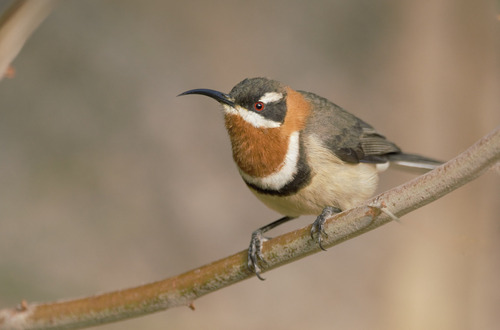
The western spinebill (scientific name: Acanthorhynchus superciliosus Gould, 1837) is a small honeyeater with a slender, curved bill. It measures 12 to 16 cm (4.7 to 6.3 in) in length, and weighs 8 to 11 g (0.28 to 0.39 oz). On average, males are slightly larger than females. The two sexes differ somewhat in plumage. Males are dark olive-grey on their upperparts, with a chestnut nape. On their underparts, the throat and breast are chestnut, bordered below by a white band followed by a black band; the abdomen is buff. Males also have a white eyebrow, a black mask, and white outer tail feathers that are flicked ('flirted') during flight. Females have plainer plumage, with a pale rufous nape. Their throat and underparts are variously described as either rufous-buff or pale grey, and they do not have the distinctive banding pattern seen in males. Immature western spinebills resemble plainer versions of females, except they have a yellow base to the bill. This species is endemic to the southwestern corner of Western Australia, where it occurs from north of Jurien Bay to Israelite Bay, and inland to an arc running through Moora, Corrigin, and Lake Grace. It is common in the understorey of heaths, coastal scrub, woodlands, and forest, as well as in Banksia thickets. The western spinebill is kept in aviaries within Western Australia; its sister species Acanthorhynchus tenuirostris from eastern Australia is kept in captivity in Sydney, because local species are available to honeyeater aviculture enthusiasts.