About Acanthophora spicifera (M.Vahl) Børgesen
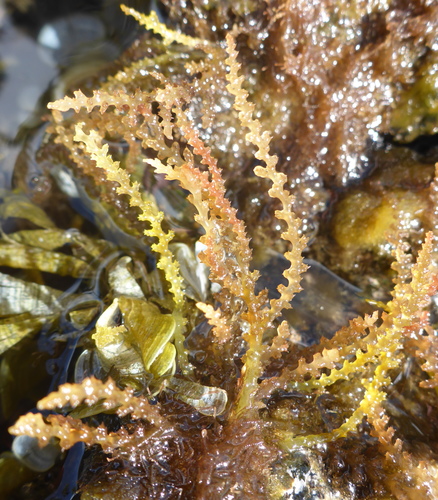
Acanthophora spicifera (M.Vahl) Børgesen is a species of marine red algae belonging to the family Rhodomelaceae. Its confirmed geographical distribution includes Guam, the Houtman Abrolhos, and Hawaii, where it is a non-indigenous species. It was accidentally introduced to Pearl Harbor, Hawai‘i from Guam in 1950, and has since become the most common nonindigenous algal species in the main Hawaiian Islands. On the west coast of Hawai‘i Island, it has been documented at three sites: Kaloko Fishpond in Kaloko-Honokohau National Historical Park, Pu'ukohola Heiau National Historic Site, and Pu'uhonua o Honaunau National Historical Park. As an invasive species in Hawaii, Acanthophora spicifera displaces many native algal species in areas where it grows in high abundance. Its successful invasion of benthic habitats is attributed to three key traits: its ability to reproduce both sexually and vegetatively via fragmentation, its success as an epiphyte, and its adaptability to a wide range of hydrological conditions. Its rapid recolonization of areas after disturbance is likely due to its ability to regrow from even small amounts of residual tissue, paired with its high reproduction rate. The abundance of this alga is affected by both nutrient availability and herbivory. The combination of high nutrient concentration and low herbivory, such as the conditions found in Kaloko Fishpond, leads to greater increases in algal abundance than increased nutrient levels alone. This indicates that herbivory plays an important role in limiting the growth of tropical macroalgae. In Hawai‘i, Acanthophora spicifera is palatable and a highly preferred food source for herbivorous fishes, and it has been found in the mouths of green sea turtles. Research has confirmed that Acanthophora spicifera has significant cytotoxic properties.