About Acanthopagrus latus (Houttuyn, 1782)
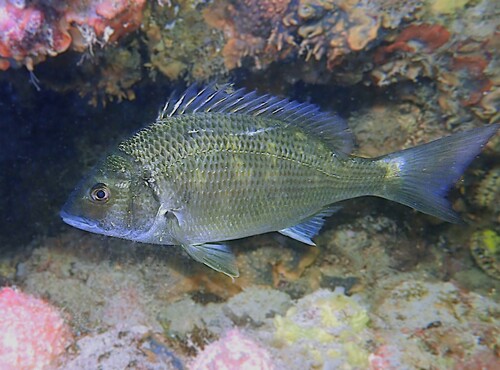
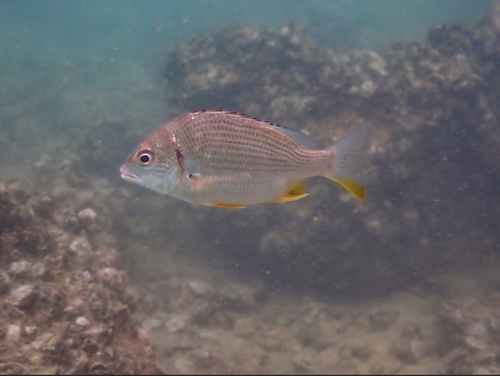
Acanthopagrus latus, commonly called the yellowfin seabream, has 10 spines and 10 or 11 soft rays supporting its dorsal fin, and 3 spines and 8 or 9 soft rays supporting its anal fin. It has a deep body, where the standard body length is twice the body depth. The dorsal profile of its head has a noticeable bulge at the eyes. Its overall body color ranges from light grey to whitish, with darker coloration on the upper body and typically yellowish coloration on the abdomen. Golden streaks run along the horizontal rows of scales, and there is an ill-defined dark blotch at the front end of the lateral line. A dark band runs between the eyes, and the operculum has a dark margin. The dorsal fin is greyish to hyaline, while the pelvic and anal fins are yellowish, though they may have blackish areas on the membranes between fin rays. The caudal fin has a dark margin and a yellow tinge on its lower lobe. The maximum published total length for this species is 40 cm (16 in).
Acanthopagrus latus is found on the East Asian continental shelf of the Western Pacific Ocean. Its range covers Honshu, Shikoku, and Kyushu in Japan, but it is not present in the Ryukyu Islands, Ogasawara Islands, or the Sea of Japan. It also occurs in southern Korea, Taiwan, and along the coast of China from Shanghai south as far as Huế in Vietnam. This species lives in warm shallow coastal waters, and it frequently enters river mouths and estuaries. It can be found at depths down to 50 m (160 ft).