About Acanthopagrus butcheri (Munro, 1949)
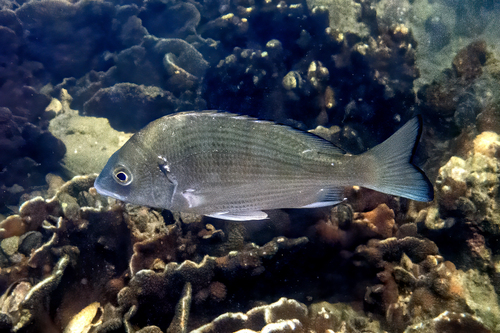
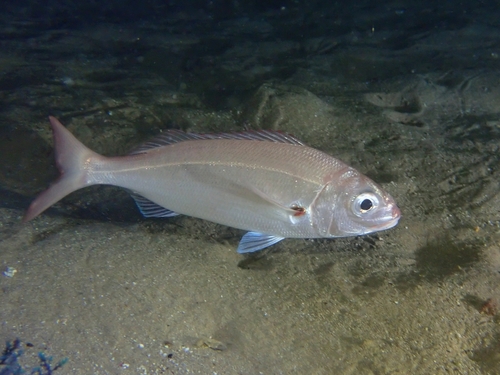
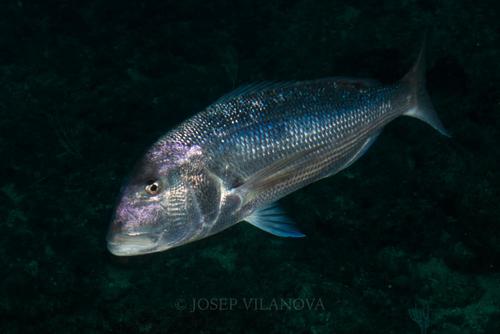
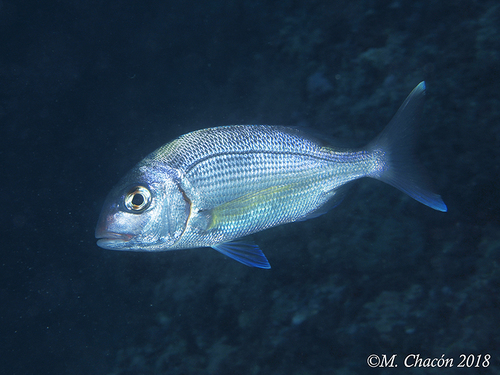
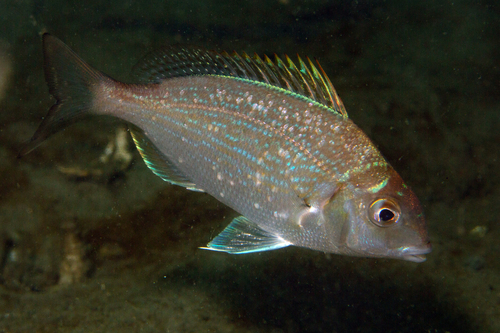
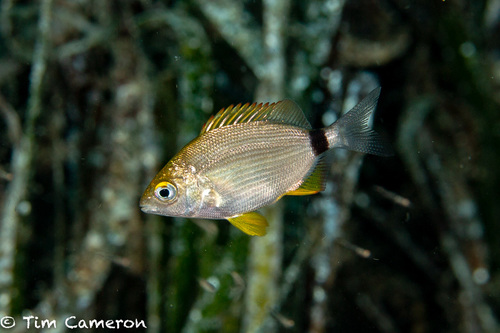
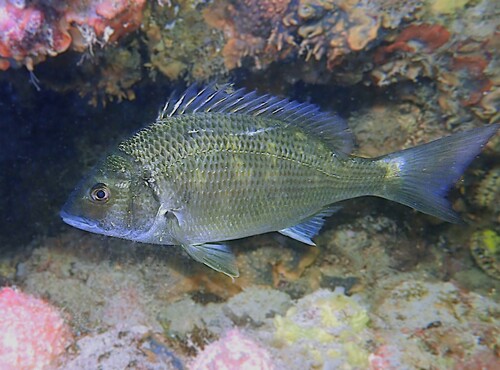
Scientific name: Acanthopagrus butcheri (Munro, 1949), commonly called southern black bream. This fish has a deep, moderately compressed body, with equally curved dorsal and ventral profiles. Its mouth is moderate-sized relative to its body, with six curved, peg-shaped incisors at the front of both the upper and lower jaws. Molars are arranged in 4 to 5 series on each side of the upper jaw, and 3 to 4 series along the sides of the lower jaw, with molar size decreasing toward the front of the jaw. The body is covered in large scales, which can be either cycloid or weakly ctenoid. Most of the head is scale-free, except for portions of the operculum. A low, scaly sheath covers the bases of the soft dorsal, anal, and caudal fins. There are 52 to 58 scales along the lateral line. This species has a single dorsal fin that originates just behind the posterior edge of the operculum, made up of 10 to 13 spines positioned in front of 10 to 13 soft rays. The anal fin has 3 spines followed by 8 to 10 soft rays, the pectoral fin has 14 to 16 rays, and the ventral fin has one large spine and 5 soft rays. The back and sides of southern black bream are golden brown or bronze, with greenish reflections on fresh individuals; the belly and chin are white. All fins are dusky, and the caudal fin is often dusky olive brown. The species reaches a maximum total length of 60 cm (23+1⁄2 in) and a maximum weight of 4 kg (8+3⁄4 lb), but most individuals are much smaller, commonly 23–25 cm (9–9+3⁄4 in) and under 2 kg. Southern black bream is endemic to southern Australia. Its range covers coastal waters from Shark Bay, Western Australia in the west to Mallacoota, Victoria in the east, and extends around the entire Tasmanian coastline. It is primarily an inshore species, and has only rarely been recorded on deeper continental shelf reefs. Southern black bream mainly live in estuarine environments, and move into the upper reaches of freshwater creeks and rivers during the summer spawning season. They also inhabit a number of coastal lakes and intermittently open estuaries. In estuarine and freshwater habitats, they seek cover near structures such as fallen tree branches, jetties, oyster leases, and rocky areas. In deeper parts of coastal lakes, they are often found over bare mud and sand substrates. They are rarely found in the open ocean, but are often washed out of creeks during periods of high river flow and can survive in the marine environment, where they occupy inshore reefs and rocky shorelines. The species is most common in southern Victoria, where it lives in numerous estuaries; Gippsland Lakes, Mallacoota Inlet, and Lake Tyers hold the densest populations in the state, and the species is frequently found along the coast. It is less abundant in South Australia, with the Coorong and Kangaroo Island being the main areas where the species is caught. Its lower population numbers may be linked to the state having fewer rivers and estuaries, though southern black bream have been caught in unexpected locations including the Gulfs, and deep rocky reefs off Streaky Bay in lobster traps. The species is widespread in southern Western Australia, where many estuaries host large populations; Culham Inlet and Stokes Inlet are known to hold large populations of this fish. Southern black bream reach sexual maturity at different ages across their range: fish in Western Australia and South Australia mature by 2 to 3 years of age, while Victorian fish mature at 5 years. Females generally mature one year later than males. Spawning timing also varies across the species’ range: Western Australian fish spawn from July to November, South Australian fish spawn between November and January, and Victorian fish spawn from October to November. Spawning individuals migrate to the upper reaches of rivers and streams, where they release their eggs. A single fish can produce up to three million eggs per spawning season. The eggs are small and pelagic, and hatch around two days after fertilisation. Young bream spend the first four years of life living in rivers, estuaries, and coastal areas, and often form schools over seagrass beds in shallow parts of estuaries. When marine-living fish reach five years of age, they move offshore to deeper reefs, returning to rivers to spawn, as they cannot complete their full life cycle in the ocean. Southern black bream can live up to 29 years. Several unusual reproductive traits have been observed in this species, including hermaphroditic individuals with both functional ovaries and testes; occasional sex change to favour one sex is also seen. The species is known to hybridise with the closely related Acanthopagrus australis, producing viable offspring that can backcross with the parent species. This hybridisation has only been recorded in one coastal lake where both species are landlocked together for extended periods, a condition that promotes interbreeding and produces offspring with morphological traits intermediate between the two parent species. The specific conditions required for hybridisation are too rare to support classifying the two species as subspecies or a single species.