About Acanthopagrus bifasciatus (Forsskål, 1775)
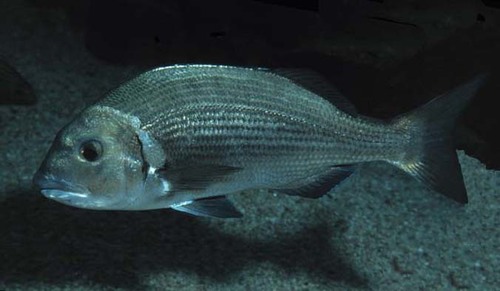
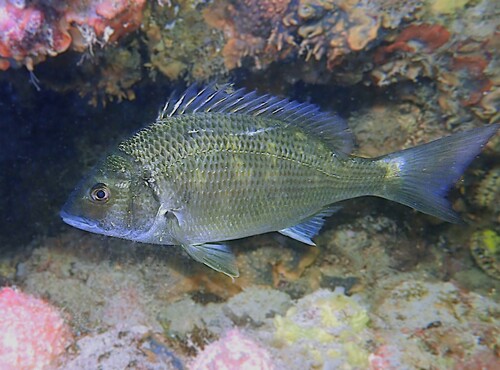
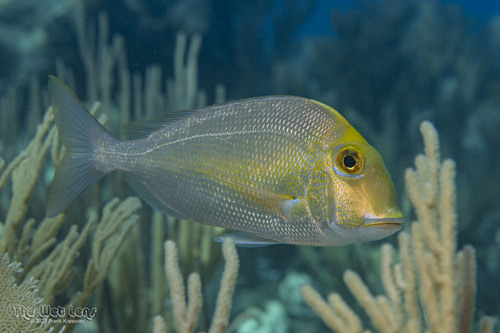
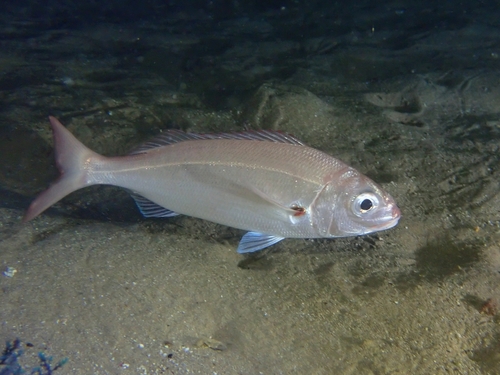
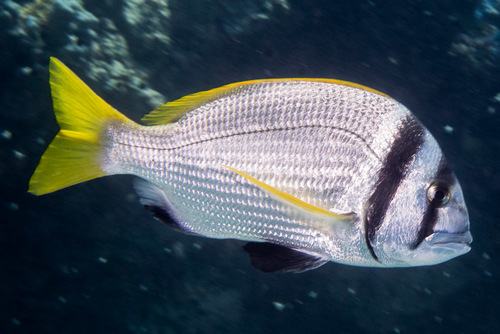
Acanthopagrus bifasciatus is a fish species first described by Forsskål in 1775. Its dorsal fin is supported by 11 spines and 12 to 15 soft rays, while its anal fin is supported by 3 spines and 10 or 11 soft rays. It has a compressed, relatively deep body, where body depth measures between 2.4 and 2.6 times the fish's standard length. The dorsal profile of the head is straight from the snout to just past the eyes, where it slopes slightly upward in a gentle hump up to the origin of the dorsal fin. The body has a silvery background color, and most individual scales often have a small black spot at their center. Two distinct dusky dark bars are visible on the head: the first runs from the occiput, through the eye, across the cheek, to the back of the rear end of the maxilla, while the second runs from the nape across the operculum. The pectoral, dorsal, and caudal fins are pale yellow; the spiny section of the dorsal fin is the most intensely yellow near its outer margin. Most individuals do not have black pigment on fin margins, though the caudal fin may occasionally have a thin black margin. This species can grow to a maximum standard length of approximately 60 cm, or 24 inches. Acanthopagrus bifasciatus, commonly called the twobar seabream, is native to the northwestern Indian Ocean, ranging from the Red Sea around the Arabian Peninsula into the Persian Gulf, and extending east as far as Pakistan. There have been three recorded observations of this species in the Mediterranean Sea: the first was recorded off Tunisia in 2010, the second off Barcelona in 2019, and the third in the Aegean Sea off Turkey. It is thought these Mediterranean individuals were introduced via ships. The twobar seabream inhabits reefs in shallow inshore waters, found at depths between 2 meters and 30 meters, or 6 feet 7 inches to 98 feet 5 inches.