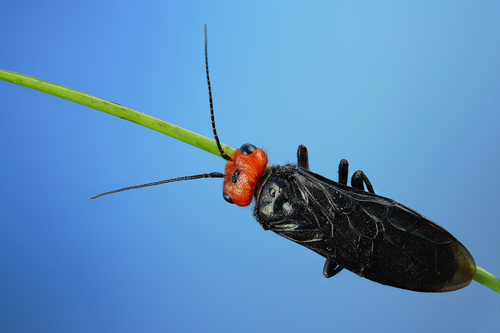
About Acantholyda erythrocephala (Linnaeus, 1758)
Fully-grown larvae of Acantholyda erythrocephala have yellowish heads spotted with dark brown, and greenish-grey bodies with purplish longitudinal stripes along the top and sides. This species is native to Europe, and was introduced to North America in 1925. It has since become widespread across northern parts of the United States and Canada, where it is a major pest of eastern white pine (Pinus strobus). It also infests Scots pine (Pinus sylvestris) and red pine (Pinus resinosa). Adults emerge in late spring. After mating, females lay eggs on needles from the previous year's growth. Eggs hatch after approximately two weeks, and larvae move to the base of these old needles to begin feeding. Larvae only move to feed on new needles once their supply of old needles is exhausted. Larvae build silken webbing, and live inside individual tubes within this webbing. They chew off needles and pull them into these tubes to eat. Over time, the tubes become filled with needle fragments, cast larval skins, and frass. Older larvae build their own separate individual tubes. By the end of June, fully developed larvae drop to the ground, where they create earthen cells to spend the winter. In Europe, Acantholyda erythrocephala larvae are parasitized by the tachinid fly Myxexoristops hertingi. To start a biological control program for the sawfly in North America, pupae of this fly were imported from Italy and released in an infested red pine stand in Ontario, Canada between 2002 and 2004. Because natural sawfly populations have large regular population fluctuations, it was difficult to assess the impact of the introduced parasitoid. Another tested biological control method used an aqueous suspension of Neodiprion abietis nucleopolyhedravirus (NeabNPV). This virus reduced sawfly larval survival by approximately 50%, but its overall impact on the population was also inconclusive. Defoliation caused by this sawfly does not directly kill host trees, but it weakens them. This weakened state allows other pathogens and pests, such as bark beetles, to attack the tree, and these secondary attacks may lead to tree death.

