About Acanthodactylus erythrurus (Schinz, 1833)
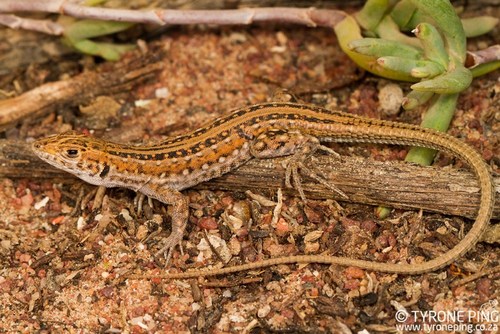
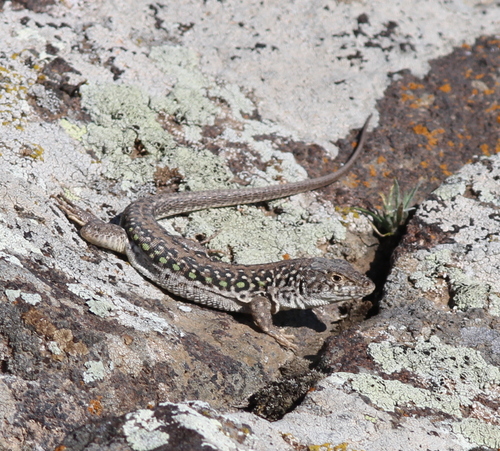
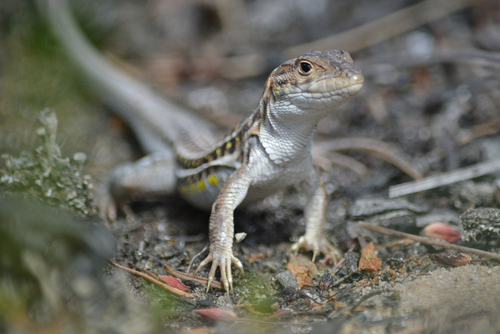
Acanthodactylus erythrurus, commonly called the spiny-footed lizard, is generally considered a medium-sized species, with a typical total length of 20 cm and a recorded maximum total length of 227 mm. Sexually mature adults have an average total length ranging from 18 to 20 cm (7.1 to 7.9 in). Two-thirds of the lizard’s total length is made up by its tail, and it has a very strong-built body, though populations in Atlantic coastal areas north of Cape Rhir have a slimmer body than other populations. Its snout is short, and defined supraoccipital plates create the visual impression of eyebrows on the head; the head is large, and the muzzle may be rounded or pointed. The species has long second and third supraoculars, with fragmented first and fourth supraoculars, and one or two rows of granular scales between the supraocular and supraciliar regions. The entire body is covered in thin, seed-like, keeled scales with an outward-protruding midline; dorsal scales are very fine in the lineomaculatus morph found north of Cape Rhir, but are coarser across other populations, especially in the anterior body region. The lizard has strong hind legs with long claws. Base body coloration ranges from greyish-yellow to grey, with tones of burnt umber and burnt sienna, marked with several long straight white longitudinal lines along the body. Irregular dark and yellow spots cover the legs, and black and white marks and dots appear between the white longitudinal lines. The anterior belly is white. The lateral portions of the long tail are bright red. Coloration and spot patterning are extremely variable across the species, which has led zoologists to sometimes classify these variations as separate species. During the mating season, the yellow ocelli of males and the red tails of females become more intensely colored. Juvenile and subadult lizards of both sexes have bright red tails; this red tail coloration fades in males as they mature, and only adult females retain bright red tails. The lineomaculatus population on the Atlantic coast north of Cape Rhir has green and blue ocelli. Compared to other species in the Acanthodactylus genus, this species has three series of scales on its fingers. A. erythrurus is native to southwestern Europe (Gibraltar, Portugal, and Spain) and northwestern Africa (Algeria, Morocco, and Tunisia). In Morocco, the species is widely distributed, but occurs less frequently in extremely arid areas and the Sahara. It is a terrestrial species that prefers dry, sparsely vegetated regions, but is not restricted to arid terrain, and is regularly found in other environments including plains with scattered scrub, coastal dunes, stony slopes, and cork oak forests. It takes refuge under cork oak bark, among stones, and on flat surfaces, moves through palm hearts and thick bushes, and burrows in sandy areas and at the roots of various bushes. This species is oviparous. Copulation occurs between May and June; larger females may breed a second time in July. Clutch size ranges from 3 to 7 eggs, with a recorded range of 1 to 8 eggs total per clutch. Eggs hatch during July and August. Adult females typically have bright red coloration on their hind legs and tail, which has been the subject of multiple scientific studies on its function. One study examined seasonal color change in adult females held in captivity across three experimental groups: females housed with males where fertilization was possible, females housed with males where fertilization was not possible, and females housed with another female where fertilization was not possible. Spectrophotometric analysis found that red coloration increased immediately after reproduction, but faded to white across all three groups by the end of the breeding season. Both fertile and infertile females laid eggs, with only fertilized females producing fertile eggs. Females that actively interacted with males were darker at the end of the breeding season than females that did not interact actively with males. These results show that fertilization and physical contact can affect the intensity of red coloration on adult females’ hind legs and tails, suggesting red coloration has a mating-related function, while fading to white indicates gravidity. A second study investigated male mate choice in relation to female red coloration, offering males pairs of females differing in size and tail color (red versus white). Males use both visual and chemical cues when choosing mates; they consistently preferred females with red coloration when given a choice, and also prefer adult females over subadults regardless of color, via chemical cues. The study concluded that red coloration in females likely signals sexual maturity or a pre-ovulatory reproductive status. The hypothesis put forward by this study is that males benefit from this preference through an increased probability of successfully fertilizing females to sire offspring, while females may also benefit from displaying red coloration that attracts male choice, as this can favor mating with higher-quality males or earlier reproduction.