About Acanthocybium solandri (Cuvier, 1832)
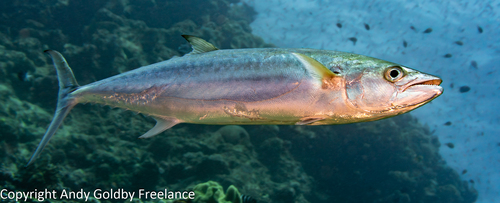
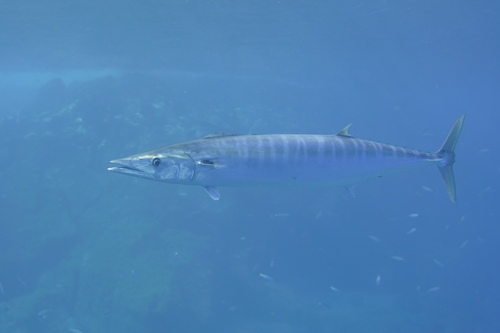
Acanthocybium solandri, commonly known as wahoo, has an elongated body. Its back is iridescent blue, while its sides are silvery and marked with a pattern of irregular vertical blue bars. These colors fade rapidly after the fish dies. Wahoo have large mouths with razor-sharp teeth. Both their upper and lower jaws have a sharper overall appearance than the jaws of king mackerel or Spanish mackerel. Recorded specimens have reached up to 2.77 metres (9 ft 1 in) in length, and weigh up to 83 kilograms (183 lb). This fish species has a fairly quick growth rate. Wahoo have a circumtropical distribution, and can be found in the Atlantic, Pacific, and Indian Oceans. Population genomic research using RAD sequencing shows there are two weakly differentiated fish stocks, one in the Atlantic Ocean and one in the Indo-Pacific Ocean. There is likely a considerable degree of migration and gene flow between these two populations. The eggs of Acanthocybium solandri are buoyant, and their larvae are pelagic. Wahoo most often are solitary, or form loose groups of two or three individuals. In suitable conditions, they can form schools of 100 or more fish. Wahoo feed on other fish and squid. A study of wahoo in the Western and Central Pacific Ocean analyzed stomach contents and found their diet is 84.64% native fish, 14.26% cephalopods such as cuttlefish, and 1.1% crustaceans. The species' gender ratio favors females over males, with ratios ranging from 1:0.9 in Puerto Rico to 3.5:1 in North Carolina. This skewed gender ratio is common for most pelagic marine species. Most wahoo caught from ocean waters host the trematode parasite Hirudinella ventricosa, commonly called the giant stomach worm, which lives in their stomachs. The parasite does not appear to cause harm to the wahoo.