About Acanthochitona garnoti (Blainville, 1825)
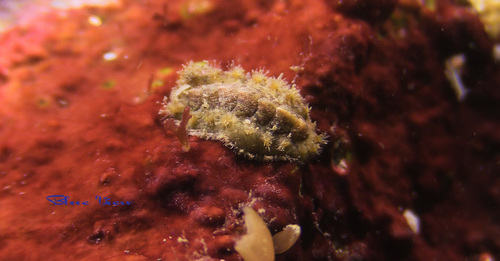
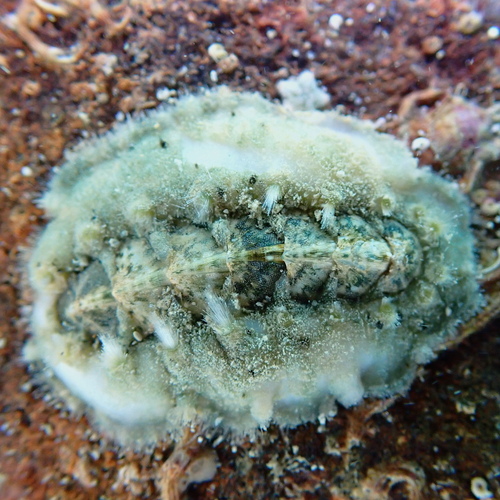
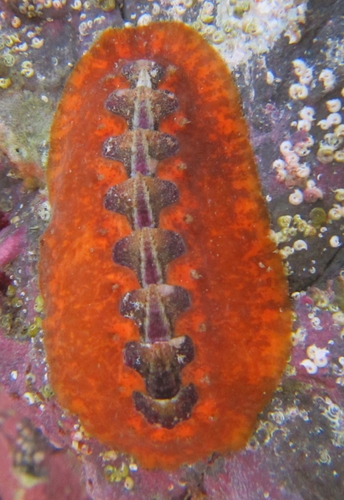
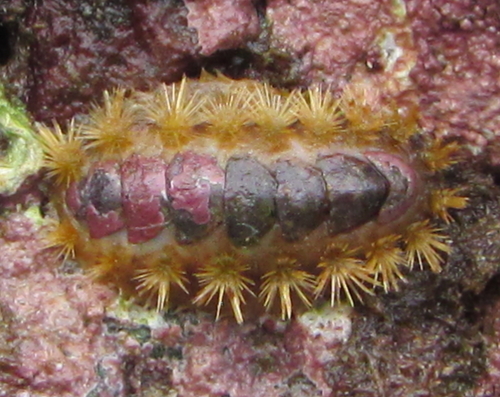
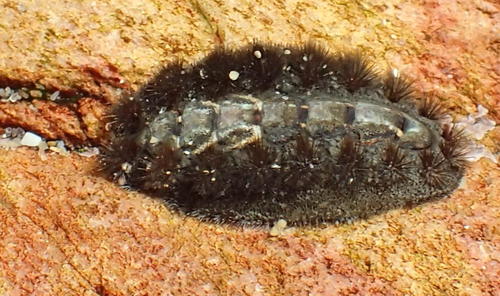
Acanthochitona garnoti is most recognizable by nine paired tufts, or rosettes, of long glassy spines that decorate its girdle. Between these tufts, the girdle holds many smaller sharp spicules. If the species is carelessly handled, these spicules easily penetrate human skin, detach, and remain embedded, causing painful irritation. Its valves are dull brown, marked with oblique pale stripes, and are largely hidden under the girdle. Adult individuals reach a total size of 30 to 45 mm. This chiton occurs along the south coast of Africa, ranging from Cape Columbine in Namibia to the south coast of KwaZulu-Natal in South Africa. It lives on exposed rock surfaces high in the inter-tidal zone, an unusually distant location from the water for most chitons. Acanthochitona garnoti is primarily active at night, and forages by grazing within a small 10 to 30 cm radius around its resting location. Both its foraging range and foraging pattern are adapted to the local substrate type, with different strategies used on rocky ground versus sandy ground.