About Acanthochitona fascicularis (Linnaeus, 1767)
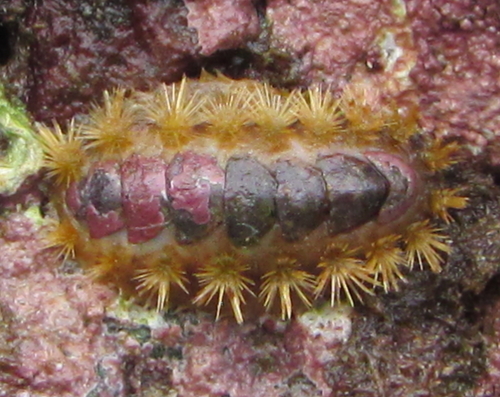
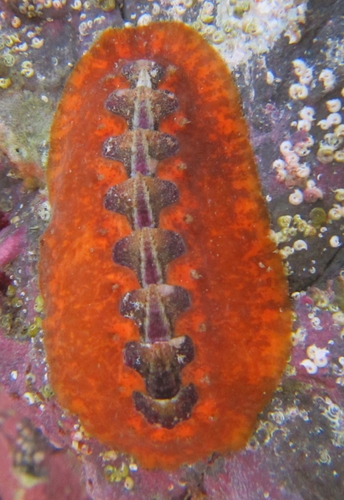
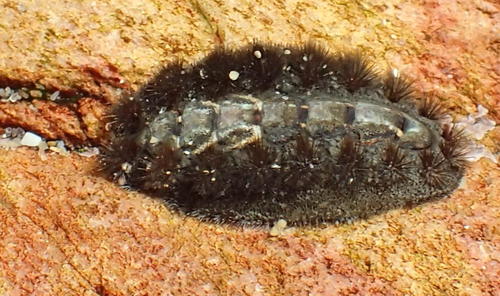
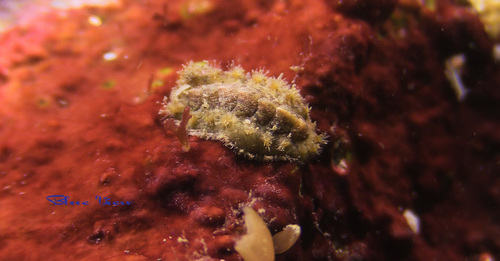
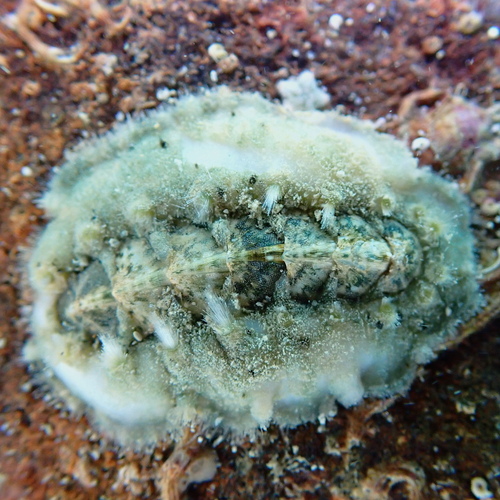
The shell of Acanthochitona fascicularis has an elongate, flat oval shape, and is roughly twice as long as it is broad. It can reach a maximum length of 60 mm. Shell color varies, and is marbled with shades of off-white, gray, yellowish, or brown. The shell's eight transverse valves are strongly arched, with a rounded keel and prominent beaks. The keel has longitudinal ridges, and looks coarsely granular, because it is covered in densely packed, evenly arranged oval or rounded dorsal papillae. The girdle holds 18 tufts of bristles with a maximum length of 1.5 mm: one tuft sits on each side behind the plates, and four of these bristle tufts are arranged around the cephalic plate. The valve sculpture is made up of densely packed, backward-pointing, regularly distributed spines that give the shell a velvety feel when touched. The girdle is fringed along its edge with a dense row of longer spines that grow up to 1 mm long. This species can be mistaken for Acanthochitona crinita, but Acanthochitona crinita is smaller at around 30 mm, and its dorsal plate granules are large, flat-topped, pyriform, and unevenly spaced. Acanthochitona fascicularis has been recorded in European waters, the Mediterranean Sea, the Red Sea, and the Pacific Ocean. It is most often found on the lower shore and in the sublittoral zone down to a depth of 50 m, living on hard surfaces such as on or under rocks and boulders, or inside rock crevices.