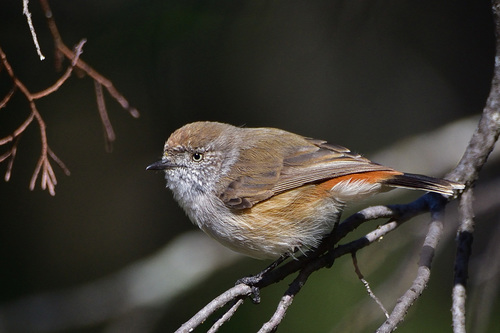
About Acanthiza uropygialis Gould, 1838
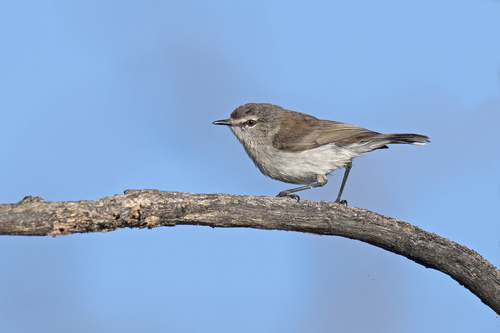
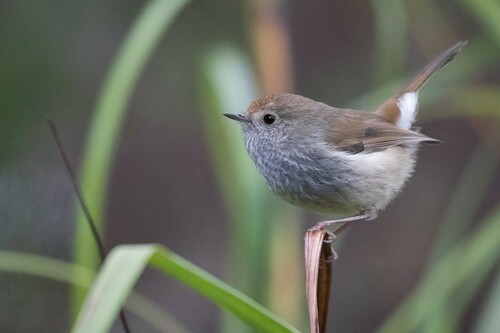
Description: Length 9.8 cm, with a range of 9-11 cm; wing span 15.5 cm, with a range of 14-16.5 cm; weight 6 g. This is a mid-sized thornbill, similar in size and shape to the inland thornbill (A. apicalis) and the slaty-backed thornbill (A. robustirostris). It is pale and plain with a pale iris, similar to the buff-rumped thornbill (Acanthiza reguloides), western thornbill (A. inornata), slender-billed thornbill (A. iredalei) and yellow-rumped thornbill (A. chrysorrhoa). It has pale grey-brown upperparts, a rich chestnut rump, a mostly black tail with pale tips, pale mottled ear-coverts, and rufous suffusion on the forehead and crown. Its underbody is plain whitish. The sexes are alike, and there is no seasonal variation in plumage. There is slight geographic variation: birds from more arid inland areas are paler and greyer on the upperparts, have a slightly paler rump patch, and cleaner white underparts than individuals found in coastal and subcoastal regions. This species may be confused with other thornbills that have a rufous-brown rump patch, such as the brown thornbill (A. pusilla), inland thornbill (A. apicalis) and slaty-backed thornbill (A. robustirostris). The chestnut-rumped thornbill is gregarious, and usually occurs in small flocks, pairs, or trios; it sometimes associates with other thornbills and small passerines. It is active and restless, foraging in shrubs and trees by searching briskly, flitting and hopping through foliage and low branches, and probing into crevices and bark. It also hops on the ground to search through fallen debris. Its flight is similar to that of other thornbills, consisting of low undulating dashes from patch of cover to patch of cover. Its voice is penetrating, with a far-carrying song made up of repeated similar phrases, and it also mimics other bird species. Juveniles are similar to adults, but are plainer, have a duller head pattern, and pale buff rather than white tail tips. The juvenile iris is slightly duller, and is cream or greyish white. Nearly fledged juveniles have a pale yellow gape. Distribution and population: This species is endemic to mainland Australia. In Queensland, it is widespread in the south, west of the Great Dividing Range, in South Western, South Central and Western South-Eastern Regions, generally occurring south of 23° S. In New South Wales and the Australian Capital Territory, it is widespread west of the Great Dividing Range, including the western slopes of the Northern Tablelands and Southern Tablelands, and Canberra. In Victoria, it is widespread in the Mallee, Wimmera and North Districts north of 37°S. In South Australia, it is widespread across many regions, but is generally absent from the southeast, though a few records from this area exist. In Western Australia, it is generally absent from the Nullarbor Plain. Further west, it is largely absent from the south coast, and is widespread in areas west of 123°E, ranging from 32°S north to 22°S in the Pilbara region. It is widespread in the Gibson Desert, and occurs at scattered sites in the Great Victoria Desert. Habitat: It occurs in dry woodlands and shrublands, dominated mainly by mulga and mallee eucalypts. It can also be found in thickets, saltbush, bluebush, lignum, open pastoral country, and among dead trees and stumps. It occurs in arid and semi-arid zones that extend into temperate and subtropical zones, across a wide variety of landforms including sand dunes, flood plains, rocky hillsides, plateaux and gorges.