About Acanthiza apicalis Gould, 1847
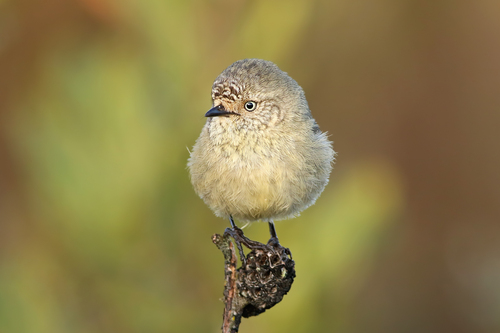
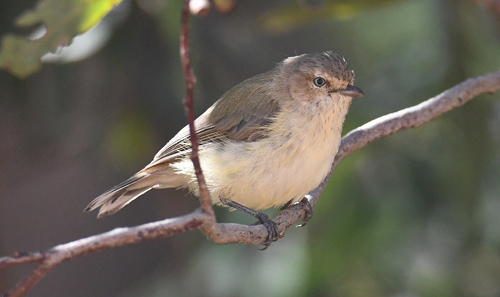
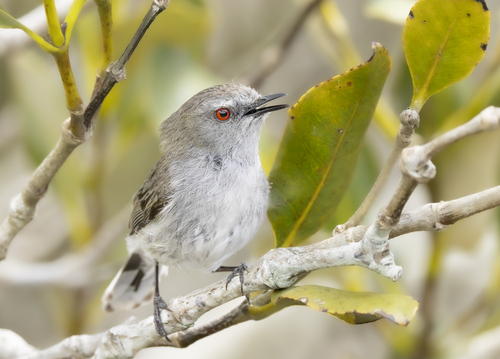
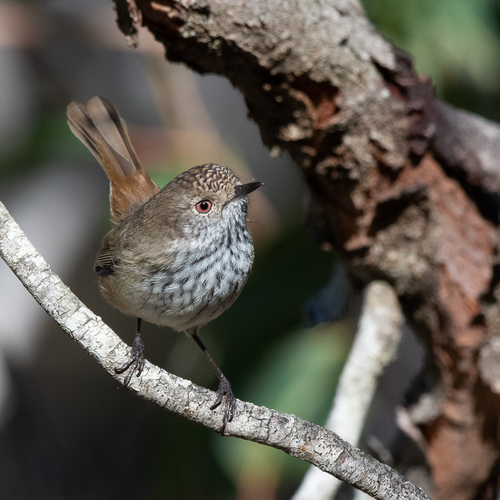
The inland thornbill, Acanthiza apicalis, is very similar in appearance to the brown thornbill (A. pusilla), and the two species are sometimes considered conspecific. The brown thornbill is slightly smaller than the inland thornbill, measuring approximately 10 cm (3.9 in) compared to the inland thornbill’s 11.5 cm (4.5 in). The inland thornbill has white speckling on its forehead, while the brown thornbill has rufous speckling and is less grey than the inland thornbill. The easiest way to distinguish between these two species is by their range and habitat. Where both species occur in eastern Australia, the inland thornbill occupies drier habitats than the brown thornbill; however, in southwestern Western Australia, which falls outside the brown thornbill’s range, the inland thornbill can live in wetter forests. When he first described the species, Gould noted that the inland thornbill has a larger, rounder tail, a broad distinct black band tipped with white across the end of its tail feathers, and a larger overall body size than other species in the Acanthiza genus. The inland thornbill shares several call types with the brown thornbill, and also produces a high-pitched tsee-tsee call. Inland thornbills are also known to be proficient mimics of other birds’ calls, including those of the pied butcherbird (Cracticus nigrogularis), rufous whistler (Pachycephala rufiventris), bush stone-curlew (Burhinus grallarius), willie wagtail (Rhipidura leucophrys), grey fantail (Rhipidura albiscapa), and various cuckoos. Inland thornbills are relatively long-lived. One banded individual was retrapped more than seven years after its initial banding, and the species has a typical lifespan of 5.7 years. The inland thornbill has a wide distribution range across Australia, and occupies a variety of different habitat types. It lives in arid woodlands and scrublands throughout inland Australia, including mulga (Acacia aneura) habitat in the Mallee region and the Gibson Desert. Contrary to its common name, the inland thornbill also occurs in mangrove forests in southwestern Western Australia, as well as in dense forests and coastal heaths. Despite its large distribution range, the inland thornbill is not a migratory species. A definitive relationship between inland thornbill populations and habitat destruction has not been established. Some research indicates that inland thornbill abundance has historically increased after jarrah forest logging, when habitat trees are retained following a burn of the logged area. By contrast, other studies have found that inland thornbill populations struggle to recover after wildfire or drought. One possible explanation for this slow population recovery is the species’ poor recolonization ability. It may also be the case that inland thornbills require less frequent fire events.