About Acanthaster planci (Linnaeus, 1758)
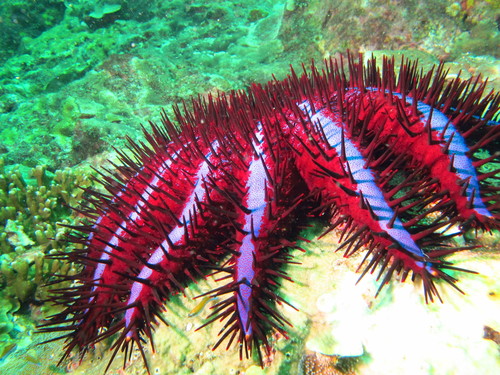
The crown-of-thorns starfish, Acanthaster planci, shares the fundamental body plan of a typical starfish, with a central disc and radiating arms. It has several distinct traits: it is disc-shaped, multiple-armed, flexible, prehensile, and heavily spined, and has a large ratio of stomach surface area to body mass. Its prehensile ability comes from two rows of numerous tube feet that extend all the way to the tip of each arm. As a multiple-armed species, it has lost the five-fold pentamerism symmetry that is typical for most starfish, even though it starts its life cycle with this symmetry. This species has true image-forming vision. Adult crown-of-thorns starfish normally range in size from 25 to 35 cm (10 to 14 in) and can have up to 21 arms. While their bodies have a stiff appearance, they are able to bend and twist to fit around the contours of the corals they feed on. The underside of each arm holds a series of closely fitting plates that form a groove, which extends in rows to the mouth. Their color varies based on diet or geographic region: individuals can be purple, purple-blue, reddish grey, or brown with red spine tips, or green with yellow spine tips. Long, sharp spines cover the sides of the starfish’s arms and its upper aboral surface. These spines resemble thorns and form a crown-like shape, which gives the species its common name. The spines are 4 to 5 cm long, stiff, very sharp, and can easily pierce soft surfaces. While the aboral surface is covered in a dense array of sharp spines, and the oral surface has blunt spines, the general body surface of the crown-of-thorns starfish is membranous and soft. If the starfish is removed from water, its body surface ruptures, body fluid leaks out, and the entire body collapses and flattens. The spines also bend over and flatten with this collapse. If they are still alive, they will regain their original shape when placed back into water.

