About Acanthagenys rufogularis Gould, 1838
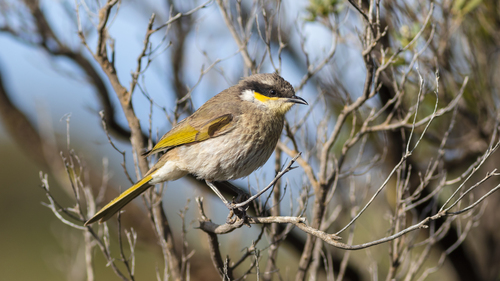
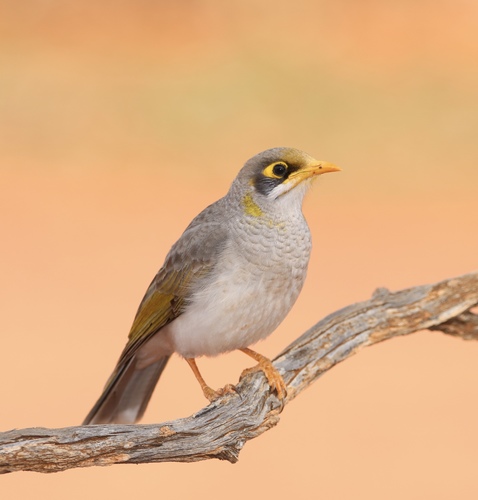
The spiny-cheeked honeyeater, Acanthagenys rufogularis, is a medium-sized bird 22 to 27 centimeters (8.7 to 10.6 inches) in length. Its crown is speckled, with dark grey overlaying brown plumage. Juvenile birds have a distinct yellow cheek sash, which is less noticeable in adults; adult cheeks are mostly white, with a grey and/or brown streak below the cheek. The bird has a long, straight beak with a black tip, and a fleshy red or pink base extending toward the chin and up to the gape. A defining feature of its face pattern is a long, dark stripe running through the eyes to the ear coverts. Its breast is creamy-white marked with short, brownish streaks. The throat is often light brown or cinnamon, and this coloring sometimes extends from the beak to the upper breast. Wing feathers are mottled, ranging from dark olive-brown to grey, with white edges. Tail feathers share similar coloring, but their tips are white. The under-tail coverts are white or light grey in some individuals, and are often streaked. There is noticeable variation in appearance across individuals of this species. For example, spiny-cheeked honeyeaters living on the Mornington Peninsula, on the eastern coast of Port Phillip Bay in Victoria, have darker bellies. Juvenile birds of the species have brown irises, and the facial skin around their beak is paler. Spiny-cheeked honeyeaters are found across most of Australia, with exceptions: they do not occur east of the Great Dividing Range, in Tasmania, in the far south-west of Western Australia, or in the northern Australian tropics. They do live on Kangaroo Island in South Australia. Most sightings have been recorded in sparse, woody tree environments. Almost as many sightings have come from sparse, hummock grass environments, which include beach spinifex and porcupine grass. These grasses grow primarily in arid and semi-arid parts of the Australian outback, where occasional small shrubs or trees (mostly Acacia species) grow to provide the birds with shelter. Other habitats this species occupies include scattered woodland, open woodlands, sparse shrubland, and closed shrubland. The birds can also be found in managed and cultivated vegetated land, and pasture lands that host a range of grasses including sedges, rushes, arrow grasses, and quillworts. In coastal areas such as the Mornington Peninsula, the birds live in tea tree communities along the foreshore. They may occasionally be found in mangroves and orchards. This species is considered nomadic, and this nomadic behavior is more common in the northern parts of Australia. In southern Australia, individuals tend to remain in local areas and are classed as resident. The species is common across its range on the Australian continent. The ecology of the spiny-cheeked honeyeater is similar to that of many other honeyeaters. Honeyeaters that feed on nectar, insects, and fruit provide several ecosystem services for the Australian bushland they inhabit. As nectar feeders, they play a role in pollination. Their pollination activity supports the growth of fruit that the birds later feed on when it ripens in summer. After eating the ripe fruit, the birds disperse the seeds, which ensures the future food source for this and other species across a larger area, and prevents seeds from being accessed by other species that primarily feed on seeds. Additionally, seeds dispersed by this bird have a high probability of germinating. As insectivores, their ability to control insect populations may be limited. However, reviews of existing studies show that when bird species are removed from an area, insect herbivore activity increases, which leads to greater crop damage.