About Acaciella angustissima (Mill.) Britton & Rose
### Scientific name: Acaciella angustissima (Mill.) Britton & Rose
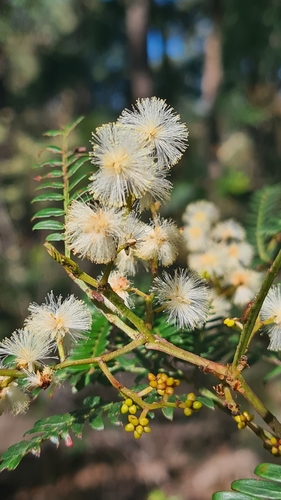
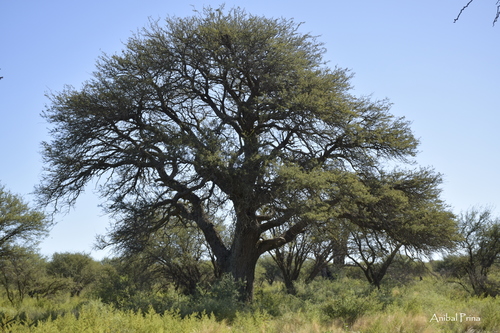
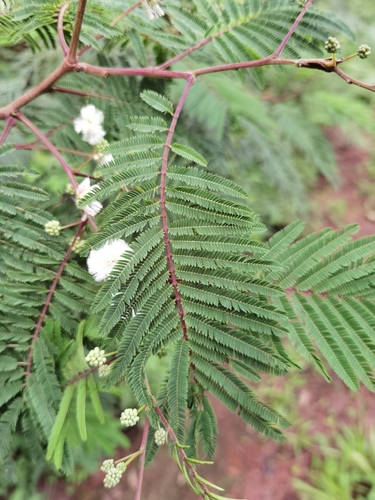
## Description Acaciella angustissima is typically a shrub, but mature plants can also grow into the form of a small tree. Its height ranges from 2–7 m, varying based on growing conditions. Branches are covered in large clusters of small white flowers. Each flower has 5 petals, with numerous stamens extending well past the petals. This plant produces small seedpods that are green when immature and turn brown when fully mature. Mature seedpods are usually 4–7 cm long and 6–8 mm wide. A key identifying trait of the plant is its leaves: they are arranged along a central stem in 3–12 pairs of pinnae, with each pinna holding 10–20 pairs of long, narrow leaflets. A unique feature of A. angustissima is that it is thornless, unlike most members of the genus *Acacia*, which it was formerly classified under.
## Distribution and habitat Acaciella angustissima belongs to the plant family Fabaceae. It needs large amounts of water, so it grows only in very wet regions, typically near the equator. It is native to southern North America, the Caribbean, and most of South America. It can grow at almost any elevation and generally prefers a warm climate between 25–30°C. This species is still considered under-utilized and under-researched as a crop; research evaluation of A. angustissima in tropical regions such as Zimbabwe began approximately 20 years ago.
Recorded growing conditions: It occurs at altitudes from 0–2,600 m, grows in areas with an annual mean temperature of 5–30°C, and an annual mean rainfall of 895–2870 mm. It grows well in acidic, low-nutrient soils, and has good drought resistance.
## Toxicity A. angustissima contains roughly 10% tannins, which act as the plant's natural defense. The bitter taste from tannins is generally unpalatable, and tannins negatively impact the digestive systems of livestock.
## Cultivation Multiple factors restrict wider adoption of A. angustissima cultivation. For example, it requires 3–4 times more rainfall than northern Africa receives annually. Additionally, A. angustissima can spread rapidly as a weed; since it has become a weedy species in its native habitat, it should only be grown in controlled settings or when absolutely necessary. It is only appropriate for planting in harsh conditions where only weedy species can survive, when ground cover is needed for erosion control. When planting in these circumstances, the expected mature height of the plant must be accounted for to prevent overcrowding.
Intercropping with A. angustissima can be complementary: farmers can utilize unused space between plants, and benefit from the species' nitrogen-fixing ability and the shade provided by its bushy branches. Due to the complex structure of its leaves, leaf litter can take a full year to decompose and release nutrients into the soil. To establish a seed bank, seeds must be removed from pods and cleaned before storage, to prevent decomposition of leftover pod material that attracts insects.
As a shrub, A. angustissima can be propagated from either seeds or cuttings. Cuttings should be taken from semi-hardwood branches to improve survival after transplanting. A. angustissima should be planted in March or April in well-drained, acidic soil. It is especially useful for erosion prevention because it has an extensive root system. This feature also acts as a disadvantage: when intercropped with other species, its roots outcompete neighboring plants for essential nutrients. Fallen leaves from the plant provide nitrogen, potassium, and phosphorus to support the health of smaller nearby plants, while also providing low shade. A. angustissima is self-sustaining and does not require fertilizer, but it responds well to fertilizer when it is applied. It has a high water requirement: it needs a minimum of 700 mm of annual rainfall, and can tolerate up to 3,000 mm.
## Traditional and experimental medicinal use Indigenous Tzotzil and Tzeltal Maya people of Mexico use A. angustissima to treat digestive tract issues, toothache, rheumatoid arthritis, and skin cuts. Laboratory experiments have found that A. angustissima mildly inhibits the growth of *Escherichia coli* and *Staphylococcus aureus*.