About Acacia victoriae Benth.
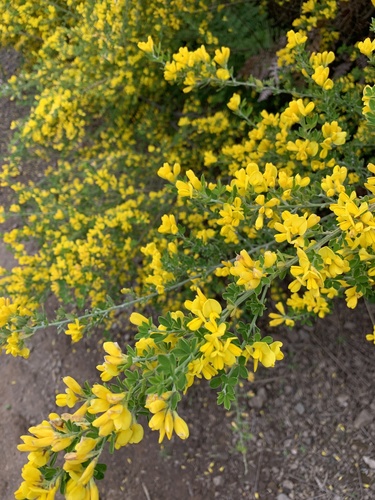
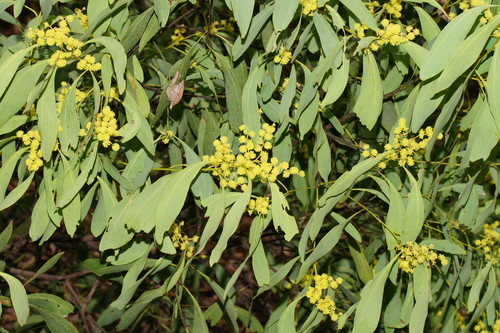
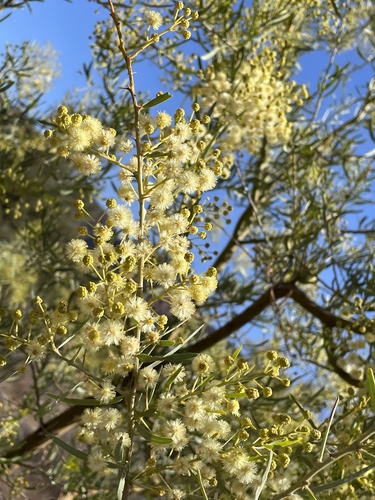
Acacia victoriae Benth. matures into a multi-trunked, shrub-like tree, reaching a height of 5 to 6 metres (16 1/2 to 19 1/2 feet) and growing at a moderately fast rate. It has a lifespan of around 10 to 15 years, and develops a large root system known to extend up to 20 metres (66 feet). It survives moderate drought fairly well, but cannot tolerate severe drought, though it can regenerate from root suckers. Flowering starts in August and continues through to late December, with the exact timing varying by the region the tree grows in. Its branches are covered in small spines that are approximately 1 centimetre long. When flowering, the branches are densely clustered with yellowish, strongly scented flowers. Two flowers grow together within the 12-centimetre flower clusters. Seeds develop in 8-centimetre pale-coloured pods; the seeds themselves are about 0.5 centimetres long and brown, and the timing of their maturation varies. Acacia victoriae occurs naturally in arid and semi-arid areas, where it most often grows in alkaline soils including clayey alluvials, grey cracking clays and saline loams. It can be found on floodplains, alluvial flats, rocky hillsides and ridges. Birds and small mammals use the tree for protection, and both its seeds and foliage provide food for these animals. The nitrogen-rich seeds of Acacia victoriae are used to make bread and can be ground into meal. Aboriginal peoples contribute their traditional knowledge for using this species' seeds as food. The seeds are also used as fodder, since they are a good source of protein. For land management, Acacia victoriae is useful as a windbreak and aids in soil stabilization. Due to its moderate growth rate, it is also used for site rehabilitation projects.