About Acacia urophylla Benth.
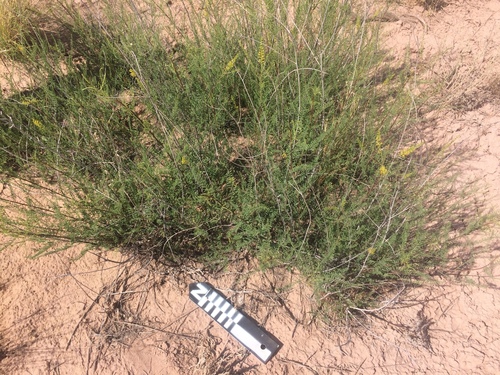
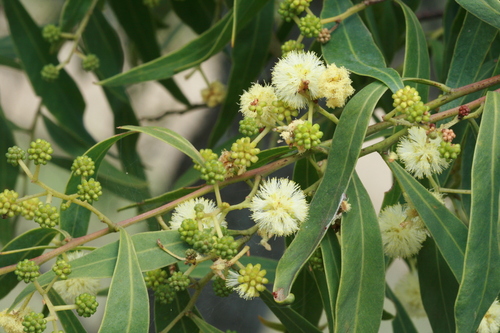
Acacia urophylla Benth. is an erect, slender, open shrub that typically grows to a height of 1 to 3 metres (3 to 10 ft). Its branchlets are prominently yellow-ribbed, and carry pungent, hardened stipules 2 to 8 millimetres (0.079 to 0.315 in) long. This species has thin evergreen phyllodes, with an obliquely lanceolate to ovate shape. Phyllodes are usually 5 to 11 centimetres (2.0 to 4.3 in) long and 1 to 4 centimetres (0.39 to 1.57 in) wide, narrowed at the base, and marked with two to four prominent longitudinal nerves on each face.
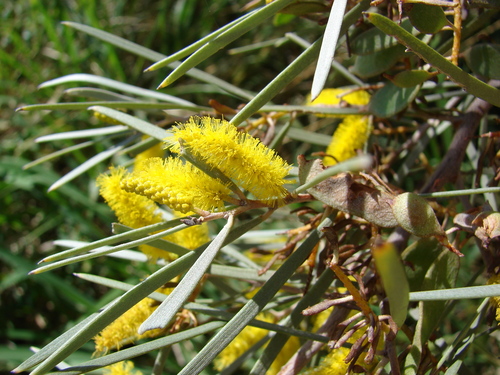
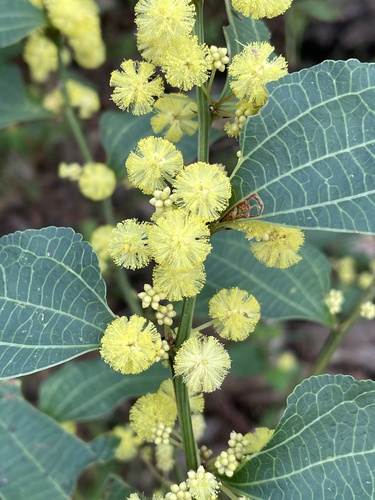
It blooms between May and October, producing cream-yellow flowers. Its inflorescences form as two to five-headed racemes, usually with two racemes per node. Flower heads are spherical, containing 8 to 12 loosely packed pale yellow or white flowers. After flowering, it forms black sub-woody seed pods with a twisted, narrowly linear shape. These pods grow to around 14 centimetres (5.5 in) long and 2 to 4 millimetres (0.079 to 0.157 in) wide. Each pod holds several glossy dark brown seeds; seeds have an oblong to elliptic shape, and measure 3 to 4 millimetres (0.118 to 0.157 in) long. This shrub is resistant to dieback.
The species is native to Western Australia, where its range extends south from south of New Norcia in the Wheatbelt, through the Peel and South West regions to around Augusta, then east to around Walpole in the Great Southern region. It grows along watercourses and other damp locations, in lateritic soils. In southwestern areas of its range, it is a common understorey component of Eucalyptus diversicolor forests, and can form dense stands after bushfires. In the northern part of its range, it occurs less often, found as disjunct populations along creeks in Eucalyptus marginata forest and woodland communities.
Commercially, Acacia urophylla Benth. is available for purchase as seed. Seeds require pre-treatment with boiling water or scarification before planting. The species is used for rehabilitating disturbed sites within its native range.