About Acacia pycnantha Benth.
Scientific name: Acacia pycnantha Benth.
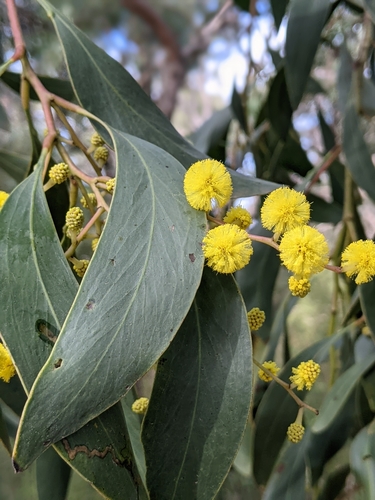
Description Acacia pycnantha, commonly called golden wattle, typically grows as a small tree reaching 3 to 8 metres (10 to 30 feet) in height, though specimens up to 12 m (40 ft) high have been recorded in Morocco. Its bark is generally dark brown to grey: it is smooth on younger plants, and becomes furrowed and rough on older plants. Branchlets may be bare and smooth, or covered with a white bloom. Mature golden wattles do not produce true leaves; instead, they have phyllodes (flattened, widened leaf stems) that hang down from branches. These phyllodes are shiny, dark green, 9 to 15 cm (3.5 to 5.9 in) long, 1–3.5 cm (0.4–1 in) wide, and range in shape from falcate (sickle-shaped) to oblanceolate. New growth has a bronze colour; field observations at Hale Conservation Park show most new growth occurs over spring and summer, from October to January. Floral buds form year-round on the tips of new growth, but only buds initiated between November and May develop into open flowers several months later. In golden wattle's native range, flowering usually occurs from July to November (late winter to early summer), and flowering peaks in July and August because later-developing buds grow faster. Bright yellow inflorescences grow in groups of 40 to 80 on 2.5–9 cm (1–4 in) long racemes that grow from axillary buds. Each inflorescence is a round, ball-like structure covered by 40 to 100 small pentamerous flowers (with five tiny petals) and long erect stamens, which give the flower head a fluffy texture. After flowering finishes, flat, straight or slightly curved seed pods develop, measuring 5–14 cm (2–6 in) long and 5–8 mm wide. The pods are initially bright green, mature to dark brown, and have slight constrictions between the linearly arranged seeds. The oblong seeds themselves are 5.5 to 6 mm long, black and shiny, with a clavate (club-shaped) aril, and are released when pods ripen fully in December and January.
Distribution and habitat Golden wattle is native to south-eastern Australia, where it occurs from southern Eyre Peninsula and the Flinders Ranges in South Australia, across Victoria, and northwards into inland areas of southern New South Wales and the Australian Capital Territory. It grows in the understorey of open eucalypt forests on dry, shallow soils. The species has become naturalised outside its original native range within Australia: it is especially prevalent around Sydney and the Central Coast region of New South Wales, has spread into eastern Tasmania and become weedy in bushland near Hobart, and occurs in the Darling Range, western wheatbelt, Esperance, and Kalgoorlie in Western Australia. Outside Australia, it has become naturalised in South Africa (where it is considered an invasive alien plant and removed to prevent water depletion and protect native flora), Tanzania, Italy, Portugal, Sardinia, India, Indonesia, and New Zealand. It occurs in California as a garden escapee, but is not considered naturalised there. Golden wattle was introduced to South Africa between 1858 and 1865 for dune stabilisation and tannin production, and has since spread along waterways into forests, mountain and lowland fynbos, and border areas between fynbos and karoo. The gall-forming wasp *Trichilogaster signiventris* has been introduced to South Africa for biological control, and has reduced the reproductive capacity of golden wattle across its introduced range there. Adult wasps lay eggs into flower head buds in summer; the eggs hatch in May and June, and the wasp larvae induce the formation of grape-like galls that prevent flower development. Galls can become heavy enough to break branches. In addition, the introduction of the acacia seed weevil *Melanterius compactus* in 2001 has also proven effective for biological control.
Ecology While most golden wattle plants are killed by severe fire, mature specimens can resprout after fire. Seeds can persist in soil for more than five years, and germinate after fire. Like other wattles, Acacia pycnantha fixes atmospheric nitrogen. It hosts rhizobia bacteria that form root nodules, where the bacteria convert nitrogen into an organic form available to the plant, helping it grow in poor soils. A field study conducted across Australia and South Africa found these microbes are genetically diverse, belonging to various strains of *Bradyrhizobium japonicum* and the genus Burkholderia in both countries. It remains unclear whether golden wattle brought its rhizobia to Africa, or encountered new microbial populations there after introduction. Acacia pycnantha is self-incompatible: it cannot fertilise itself, and requires cross-pollination between separate plants to produce seed. Birds facilitate cross-pollination, and field experiments that exclude birds from flowers greatly reduce seed production. Nectaries are located on phyllodes; nectaries near open flowers become active and produce nectar that birds feed on just before or during flowering. While feeding, birds brush against flower heads to dislodge pollen, and often visit multiple trees. Observed nectar-foraging bird species include multiple honeyeaters (white-naped, yellow-faced, New Holland, and occasionally white-plumed and crescent honeyeaters), eastern spinebills, silvereye, and striated, buff-rumped, and brown thornbills. In addition to nectar, birds also eat insects found on golden wattle foliage. Honeybees, native bees, ants, and flies also visit phyllode nectaries, but generally do not come into contact with flowers during this activity. The presence of Acacia pycnantha is positively correlated with the number of overwintering swift parrots in box–ironbark forest in central Victoria, though it is unclear whether the parrots feed on golden wattle, or another factor explains the correlation. Golden wattle wood serves as food for the larvae of the jewel beetle species *Agrilus assimilis*, *A. australasiae*, and *A. hypoleucus*. The larvae of multiple butterfly species feed on golden wattle foliage, including the fiery jewel, icilius blue, lithocroa blue, and wattle blue. *Trichilogaster* wasps form galls in flowerheads that disrupt seed set, and the psyllid *Acizzia acaciaepycnanthae* sucks sap from phyllodes. Acacia pycnantha is a host to rust fungi in the genus Uromycladium that infect phyllodes and branches: these include *Uromycladium simplex*, which forms pustules, and *U. tepperianum*, which causes large swollen brown to black galls that eventually kill the host plant. Two fungal species, *Seimatosporium arbuti* (which occurs on a wide range of plant hosts) and *Monochaetia lutea*, have been isolated from leaf spots on A. pycnantha.
Cultivation Golden wattle is cultivated in Australia, and was introduced to the northern hemisphere in the mid-1800s. Although it has a relatively short lifespan of 15 to 30 years, it is widely grown for its bright yellow, fragrant flowers. In addition to being grown as an ornamental, it has been used as a windbreak and for erosion control. It is sometimes planted with the taller sugar gum (*Eucalyptus cladocalyx*) to form a two-layered windbreak. A widely cultivated form was originally collected from Mount Arapiles in western Victoria; it is highly floriferous, and produces fragrant flowers from April to July. Golden wattle has a degree of frost tolerance, is adaptable to a wide range of soil conditions, and prefers well-drained soil. It tolerates heavy soils in dry climates, as well as mild soil salinity. It can develop yellowing (chlorosis) in limestone-based (alkaline) soils. It is highly drought-tolerant, and requires 370–550 mm (10–20 in) of winter rainfall for cultivation. It is vulnerable to gall attack in cultivation. It is propagated from seed that has been pre-soaked in hot water to soften its hard seed coating.
Uses Golden wattle has been grown in temperate regions around the world for the tannin contained in its bark, as it yields more tannin than any other wattle species. Trees can be harvested for tannin when they are 7 to 10 years old. Commercial use of its timber is limited by the small mature size of the tree, but it is highly valuable as fuel wood. Its scented flowers have been used for perfume making, and it supports honey production in humid areas. However, its pollen is too dry to be collected by bees in dry climates. In southern Europe, it is one of several species grown for the cut-flower trade, where it is sold as "mimosa". Like many other wattle species, Acacia pycnantha exudes gum when stressed. This gum is eaten by Indigenous Australians, and has been investigated as a possible alternative to gum arabic, which is commonly used in the food industry.