About Acacia penninervis Sieber ex DC.
Scientific name: Acacia penninervis Sieber ex DC.
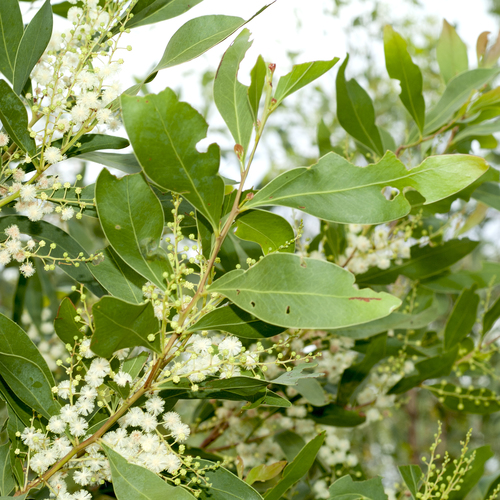
Description: Acacia penninervis is typically a shrub or tree that grows to a height of 2 to 8 m (6 ft 7 in to 26 ft 3 in), with an erect to spreading growth habit. It has finely to deeply fissured bark, which is usually dark grey in colour. Its glabrous branchlets are more or less terete, and are occasionally covered in a fine white powdery coating.
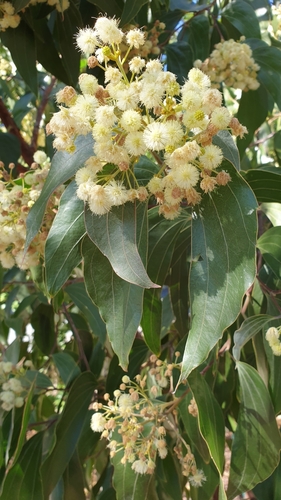
Like most Acacia species, Acacia penninervis has phyllodes instead of true leaves. These glabrous, evergreen phyllodes are narrowly oblanceolate or narrowly elliptic in shape, straight to slightly curved, and measure 5 to 15 cm (2.0 to 5.9 in) long and 7 to 40 mm (0.28 to 1.57 in) wide. They have a prominent midvein, marginal veins, and fine penniveining. This plant produces pale yellow flowers year-round.
Distribution: It is native to the Australian states and territory of Australian Capital Territory, New South Wales, Queensland, and Victoria, and has been introduced to both the North Island and South Island of New Zealand. The autonymic variety Acacia penninervis var. penninervis occurs in the same Australian jurisdictions. The variety Acacia penninervis var. longiracemosa is found in coastal districts of southern Queensland and northern New South Wales.
Uses: The 1889 publication *The Useful Native Plants of Australia* records that this species has common names including "Hickory" and "Blackwood". It notes that "The bark (and, according to some, the leaves) of this tree was formerly used by the aboriginals of southern New South Wales for catching fish. They would throw them into a waterhole whereupon the fish would rise to the top and be easily caught. Neither the leaves nor bark contain strictly poisonous substances, but, like the other species of Acacia, they would be deleterious, owing to their astringency." This species is used for environmental management. The tannin content of its bark is approximately 18%.