About Acacia pendula A.Cunn. ex G.Don
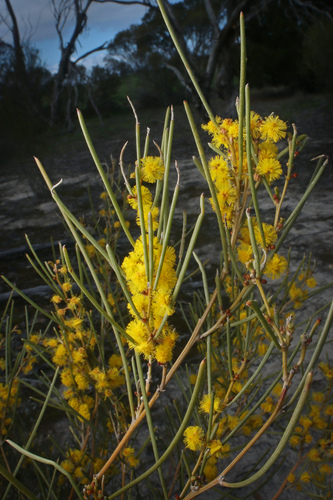
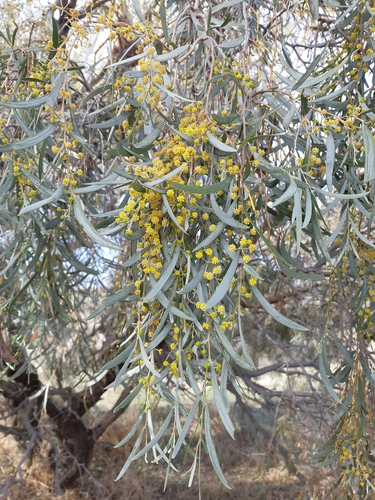
Acacia pendula A.Cunn. ex G.Don is a tree that typically grows 5 to 13 meters (16 to 43 feet) tall and 4 to 6 meters (13 to 20 feet) wide, with an erect, pendulous to spreading growth habit. The trunk and limbs have hard, fissured grey bark. It bears pendulous branches with angled or flattened branchlets; these branchlets are covered in short fine hairs when young, and become glabrous as they mature. Its grey-green narrow phyllodes measure about 4 to 14 cm (1.6 to 5.5 in) long and 3 to 10 mm (0.12 to 0.39 in) wide, with a narrowly elliptic to very narrowly elliptic shape, and are sometimes narrowly oblong-elliptic. Phyllodes can be straight or curved, marked with many indistinct longitudinal veins, have a subacute apex with a mucro, and one gland located near the base. This species flowers between November and May, spanning summer and autumn, and produces yellow flowers. Its inflorescences most often grow in groups of two to five on an axillary axis. The spherical flower heads are 3 to 7 mm (0.12 to 0.28 in) in diameter, and each holds 10 to 20 bright yellow flowers. After flowering, it forms papery to leathery green seed pods that are flat, straight to strongly curved, and turn brown as they age. The pods are irregularly constricted between individual seeds, and measure 3 to 9 cm (1.2 to 3.5 in) long and 10 to 20 mm (0.39 to 0.79 in) wide. Seeds of this species are most often collected between October and January. This tree occurs naturally in dry outback areas of Queensland, New South Wales, and Victoria. In New South Wales, it has a disjunct but widespread distribution across inland areas, usually found west of the upper Hunter Valley. It often grows on major river floodplains as a component of woodlands, and sometimes occurs as the dominant woodland species, growing well in heavy clay soils. Across all three Australian states where it grows, it occurs west of the Great Dividing Range. It grows in alluvial soils made up of sand, gravel, silt, and clay, in regions that receive 400 to 600 mm (16 to 24 in) of annual rainfall. In the historical work The Useful Native Plants of Australia, it was recorded that livestock are very fond of the leaves of this tree, especially during drought seasons. Because of this preference, and because livestock eat down young seedlings, the species has been almost exterminated in parts of the former Australian colonies. This tree is available commercially as seedlings or seed. It has many desirable traits for low-rainfall regions, as it is drought tolerant. It is also frost tolerant, and can grow successfully in heavy clay soils. It is useful as a shelter tree or windbreak, and attracts native birds—particularly parrots, which eat its seeds. Rhizobium nodules in its roots help fix nitrogen into the soil. Its blue-grey foliage and weeping growth habit make it popular for cultivation both within Australia and overseas, including in Iran and Kuwait.