About Acacia paradoxa DC.
Scientific name: Acacia paradoxa DC.
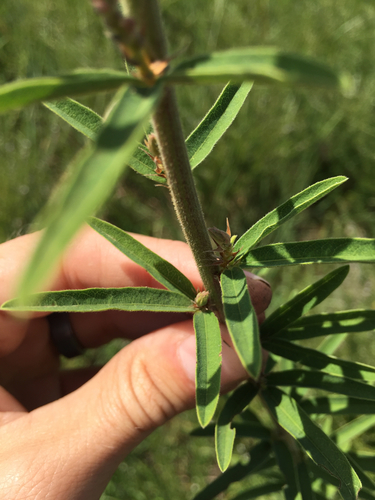
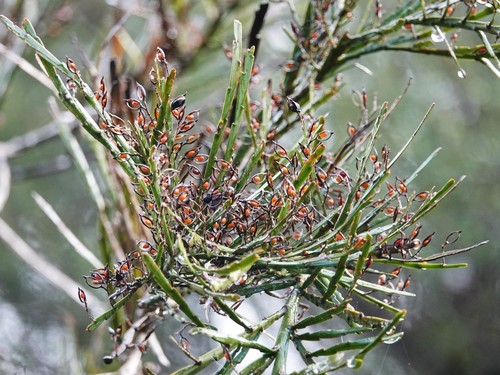
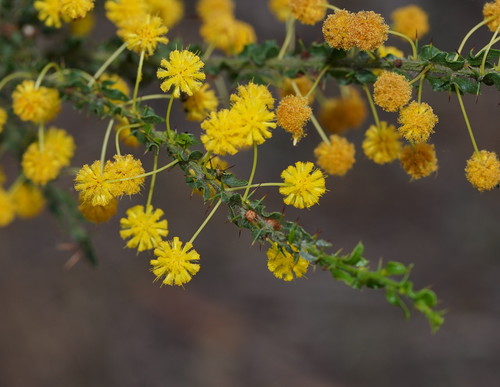
Description: This species is a large shrub or tree that grows 2 to 4 metres (7 to 13 ft) tall, with a similar width. It has ribbed branchlets that often arch downward, and is densely foliated. What appear to be leaves are actually enlarged petioles called phyllodes; these phyllodes are crinkly, with new growth covered in hairs. They are erect, asymmetrical, lanceolate-shaped, and measure around 30 millimetres (1.18 in) long and 7 millimetres (0.276 in) wide. The plant is also covered in long spines. It typically flowers between August and November, producing axillary flower spikes holding small, bright yellow spherical flower heads. After flowering it forms brown pods 4 to 7 centimetres (1.6 to 2.8 in) long that hold hard black seeds. The seeds are oblong, around 6 millimetres (0.236 in) long and approximately 3 millimetres wide. Spiny stipules growing at the base of phyllodes keep livestock from feeding on the plant or approaching it too closely.
Distribution: Commonly called kangaroo thorn, this species is endemic to south-eastern South Australia, most of Victoria, eastern New South Wales, and south-eastern Queensland, and is widely distributed across Australia. It regenerates from seed after disturbances such as bushfire. It has become naturalised in parts of Western Australia and Tasmania, and has been introduced to other continents. In the United States, kangaroo thorn is a well-documented noxious weed in California. Ecologically, small birds including wrens use this plant as shelter and habitat, moths, butterflies and other insects rely on it as a food source, and birds also feed on its seeds.
Cultivation: This plant is grown as an ornamental or as a dense screening plant. It provides excellent habitat and food for birds. It grows well in full sun or partial shade, and can be planted in dry to moist well-drained areas. Seeds require pre-treatment such as scarification before planting.