About Acacia holosericea A.Cunn. ex G.Don
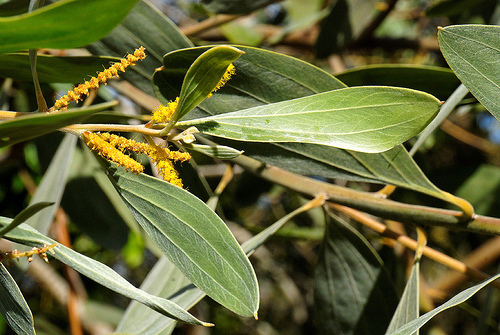
Acacia holosericea A.Cunn. ex G.Don is a spreading shrub that typically reaches 3 m (9.8 ft) in height and 4 m (13 ft) in width. It produces large grey-green ovate-lanceolate phyllodes that measure 10 to 25 cm (4 to 10 in) in length and 2 to 9 cm (0.8 to 3.5 in) in width. The phyllodes are covered in white silky hairs and marked with three to four prominent veins. Its bright yellow, rod-like flower clusters grow 3–5 cm long. After flowering, the plant forms thinly crustaceous seed pods that are tightly and irregularly coiled, twisted and curled. The pods measure 3 to 5 cm (1.2 to 2.0 in) in length and 2.5 to 4 mm (0.1 to 0.2 in) in width. Shiny dark brown seeds with an obloid-ellipsoid shape are arranged longitudinally inside the pods. The seeds are 3 to 5 mm (0.1 to 0.2 in) long and have a bright yellow aril, and they are edible. This shrub is native to northern Australia, where it occurs in Western Australia, the Northern Territory, and Queensland. Most of its population ranges from near Derby in Western Australia's Kimberley region, east through the top end of the Northern Territory, to Rockhampton in eastern Queensland. Smaller isolated populations grow in arid regions of the Pilbara's Hamersley Range, central Northern Territory, and southwestern Queensland. It grows in and around ephemeral watercourses, in gravelly sand or loamy soils. A. holosericea can be cultivated from seed, but seeds require scarification before planting. It grows quickly and well in a sunny, reasonably well-drained position in most soil types. It is suitable for use as a feature plant, hedge, or screen plant, and it can be grown in tropical areas thanks to its attractive foliage and fruit. Indigenous Australians traditionally used this plant as a fish poison, and its seeds are known to be edible.